


Not all logistics is the same. Confusing inbound with outbound, freight with warehouse, or a third-party logistics provider (3PL) with “not my problem anymore” costs money — in line stops, bounced appointments, unbudgeted returns, and accessorials nobody measured.
These are the nine most common types operating in Mexico and the operational truth that matters for each. Knowing definitions does not cut cost. Measuring what each type costs you — with a key performance indicator (KPI) and evidence before you pay — does. OCL Cargo is an autonomous transportation management system (TMS) that matches freight and the shipment file; the pattern when you leave sampling is recovering 5–7% of audited spend in a 6–8 week pilot.
- same word “logistics”, different costs
- 9 types
- per type: the one that moves pesos
- 1 KPI
- typical recovery auditing 100% of the pilot
- 5–7%
- pilot without replacing tools on day one
- 6–8 wk
Cluster context: what is logistics · what is a shipment · freight accessorials.
Not all logistics is the same
In Mexico, “logistics” is used for almost everything: the truck, the DC, the Laredo crossing, the last-mile courier, and the 3PL that “handles it.” The problem is not vocabulary: it is that each type destroys (or protects) margin through a different mechanism.
Inbound is not measured in freight pesos: it is measured in line stops when the supplier misses OTIF (On Time In Full). Outbound is punished when the unit bounces at the appointment. Cold chain does not forgive a thermal excursion. Foreign trade does not forgive a file without substance before Mexico’s tax authority (SAT).
If your dashboard only shows “freight cost / shipment,” you are averaging nine realities. The first operating step is to name the type, assign the right KPI, and define which evidence closes payment or dispute.
Matrix: 9 types × truth × KPI × leak
Use this table in the operations and finance meeting. If a type has no owner, KPI, or cost center, the leak is already normalized.
Inbound
Operational truth: Not measured in freight: measured in line stops
KPI: Supplier OTIF
Typical leak: Stoppage, overtime, material shortage
Outbound
Operational truth: The most expensive freight is the one that bounces at the appointment
KPI: OTIF / fill rate
Typical leak: Re-delivery, penalties, customer OTIF
Reverse logistics
Operational truth: The return costs more than the outbound leg
KPI: Cost per return
Typical leak: Returns with no budget or owner
Outsourced (3PL/4PL)
Operational truth: You delegate execution. Never the evidence
KPI: Margin vs rate
Typical leak: Paying without a file / opaque margin
Warehouse
Operational truth: What does not turn pays rent every day
KPI: Turns / accuracy
Typical leak: Dead inventory + picking errors
Freight transport
Operational truth: The rate is contracted per trip; the leak is in accessorials
KPI: Cost per km
Typical leak: Detention, lumper, delays, deadhead
Foreign trade
Operational truth: Without documentary substance, SAT does not forgive
KPI: Crossing time
Typical leak: Delays, penalties, lost tariff preference
Cold chain
Operational truth: A thermal excursion is not discounted: it destroys the lot
KPI: Continuous temperature
Typical leak: Destruction, recall, DC rejection
Last mile
Operational truth: The last leg takes ~half the shipment cost
KPI: First-attempt delivery
Typical leak: Retries, fails, poorly booked windows
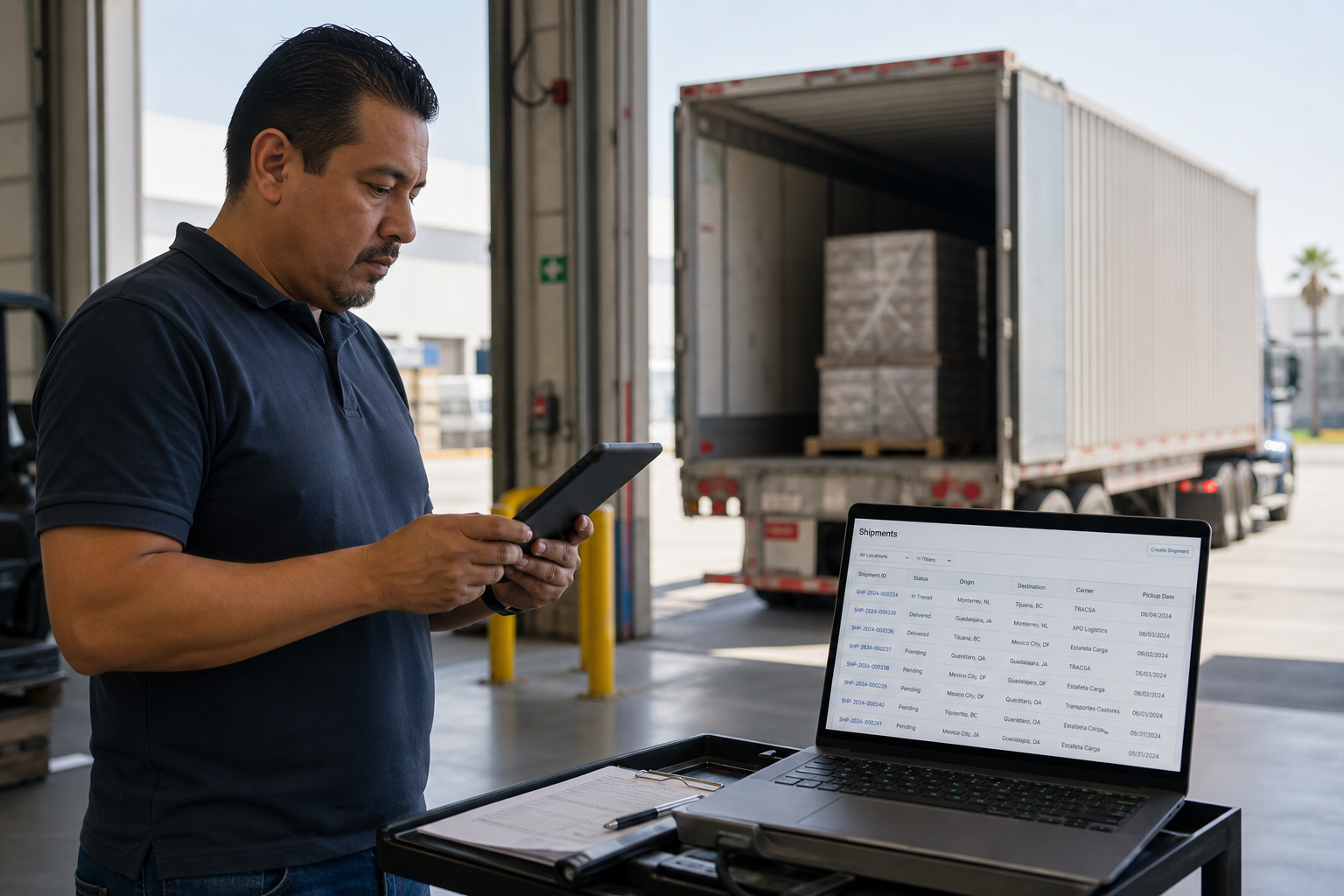
Inbound and outbound: stops vs appointments
Inbound is the flow from the supplier into your plant or DC. Freight can look “cheap” and still be ruinous: if material is not on time and complete, the line stops. That is why the KPI is not cost per km — it is supplier OTIF.
What is measured poorly: an inbound rate card not tied to appointments, dock windows, and goods acceptance. What is measured well: OTIF by supplier, dock wait minutes, and root cause of shortages (supplier, carrier, or receiving).
Outbound is the flow to the customer. Here the most expensive freight is almost never the base rate: it is the trip that bounces at the appointment, gets rescheduled, and wrecks customer OTIF / fill rate. A DC that gives you one hour and rejects a late arrival turns “freight savings” into penalties and re-delivery.
Both flows share appointment discipline and delivery evidence, but the owner of the pain changes: inbound hurts production; outbound hurts the customer and commercial margin. Go deeper on the control object in what is a shipment.
Reverse logistics: the unbudgeted return
Returns — product returns, pickups, packaging, damaged goods — usually cost more than the outbound leg: thinner routes, improvised appointments, damaged merchandise, and weak rate negotiation. And almost nobody budgets them as their own line.
KPI: cost per return (and, if applicable, % of product recoverability). If reverse lives inside “general freight,” the committee never raises the priority: cost dilutes until e-commerce volume or DC rejects make it visible.
Minimum playbook: a separate cost center, return authorization with photo/evidence, and matching the return invoice to the original order. Without that, you pay for the trip twice and the dispute once.
Outsourced (3PL/4PL): execute, never cede evidence
A 3PL (third-party logistics) executes warehouse, transport, or both. A 4PL (fourth-party logistics) integrates and orchestrates multiple providers. In both cases the operational truth is the same: you delegate execution; never the evidence.
KPI: margin vs rate — what they charge, what they deliver, and what you can prove. If the 3PL invoices and you pay without matching rate + documents + GPS + proof of delivery (POD), you bought opacity with an “outsourcing” label.
Fiscal and documentary roles in Mexico: 3PL intermediary, CFDI, and Carta Porte. Audit case with agents: logistics operator — $3.6M MXN in 6 weeks.
Warehouse: what does not turn pays rent
The warehouse is not “space”: it is immobilized capital plus picking, packing, and dock labor. What does not turn pays rent every day — in square meters, in obsolescence, and in errors that later become customer claims.
KPI: turns and accuracy (inventory and picking). A warehouse management system (WMS) without cycle-count discipline only digitizes disorder. The handoff to freight matters: a well-documented shipment is born at the dock, not in the carrier’s PDF.
Deep guide on functions and measurement: warehouse functions.
Freight transport: the leak is in accessorials
This is where many shippers learn the hard way. The rate is contracted per trip (or per km / weight). The leak is in accessorials: detention, lumper, deadhead, border delays, re-deliveries. The control KPI cannot be only “average rate”; you need cost per km (or per shipment) all-in — base + fuel + extras — and line-by-line matching before you pay.
Without 100% coverage, accounts payable releases invoices that “look reasonable” while 8–15% of the all-in hides in poorly evidenced charges. That is why the OCL pattern when auditing the full pilot universe is recovering 5–7% of spend.
Operating hub: freight accessorials for shippers and 3PLs · glossary: what are accessorial charges.
Foreign trade: no documentary substance, no mercy
On the Mexico–US corridor, the crossing is not just a GPS pin on the bridge. It is pedimento, value, origin, Carta Porte, and a file that survives review. Without documentary substance, SAT does not forgive — and the cost shows up as delay, storage, penalty, or lost tariff preference.
KPI: crossing time (and % of releases on the first documented attempt). A tower that only watches ETA without tying XML, packing list, and transfer proof is flying blind.
Core transport-side piece: what is Carta Porte. OCL verifies on the buyer side; it is and can stamp CFDI.
Cold chain: one excursion destroys the lot
In food, pharma, or sensitive chemicals, a thermal excursion is not “discounted” like an accessorial: it destroys the lot, triggers DC rejection, or opens a recall. The KPI is not cost per km — it is continuous temperature with a log tied to the shipment ID.
If thermal evidence lives in the carrier portal and the POD lives in WhatsApp, you already lost the dispute. Delivery reconciliation and documented custody are the standard when the product does not tolerate averages.
Last mile: the leg that eats the margin
The last leg — from DC or hub to the home or store — can take nearly half the shipment cost. The KPI that matters is first-attempt delivery: every retry burns fuel, courier time, and the customer promise.
Badly booked windows, incomplete addresses, and “leave it with the neighbor” without evidence turn last mile into a margin hole. Definition and limits: what is last mile.
How to audit cost by type
You do not need a two-year project. You need an honest inventory: which types you run, who owns them, which KPI you watch today, and which evidence accounts payable requires before releasing payment.
Elige un paso para ver el detalle
Detalle del paso · 01
Name the types you actually run
Step 1
Measure freight and evidence across types
The nine types do not require nine systems on day one. They require one file per trip and agents that match the repeatable work before accounts payable releases payment. OCL Cargo operates as an autonomous TMS with computer use: it works on portals and screens, coexists with your TMS or ERP, and escalates exceptions to your team.
OCL order
From type to payment
Identify type
KPI and owner
Tie evidence
One trip ID
Audit pre-pay
100% of pilot
Decide scale
Hours and MXN
Without replacing your current tools on day one: pilot on one corridor, 100% coverage of the flow, typical recovery pattern 5–7%. You decide with a file; OCL is not a PAC.
Record vs execution comparison: traditional TMS vs OCL. Human-bridge thesis: false digitization of freight.
Key takeaways5 points
- Not all logistics is the same: mixing inbound, outbound, reverse, 3PL, warehouse, freight, foreign trade, cold chain, and last mile blends costs and hides leaks.
- Knowing definitions does not cut cost. Measuring the right KPI (and typical leak) for each type does.
- In freight transport the rate is contracted per trip; the leak usually lives in accessorials. In reverse, the return almost never has its own budget.
- Delegating execution to a third-party logistics provider (3PL) or a fourth-party integrator (4PL) does not delegate evidence: accounts payable still needs a complete file.
- OCL pattern: auditing 100% of the pilot flow typically recovers 5–7% of freight spend in 6–8 weeks, without migrating the TMS on day one.
Do you already know which type is leaking money?
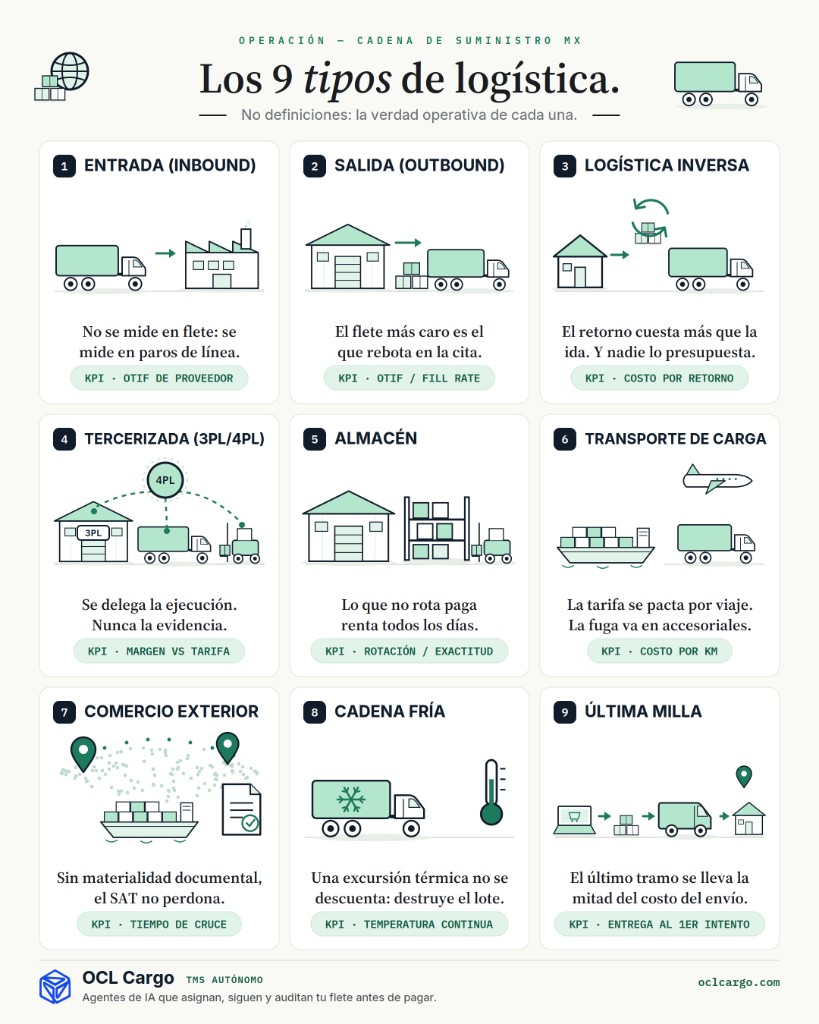
Infographic: the 9 types on one page
One page to align operations and finance: operational truth and KPI by type. Use it in Monday’s meeting — not as pitch decoration.
Related reading
Frequently asked questions
Inbound, outbound, reverse logistics, outsourced (3PL/4PL), warehouse, freight transport, foreign trade, cold chain, and last mile. Each is measured with a different key performance indicator (KPI); mixing them hides cost leaks.
Definitions do not cut cost. Measuring each type’s typical leak (line stops, missed appointments, unbudgeted returns, accessorials, dead inventory rent, border delay, temperature, first-attempt delivery) and auditing evidence before you pay does.
OTIF (On Time In Full) measures whether the supplier or shipment arrived on the agreed appointment with the correct quantity. It is the core KPI for inbound (supplier) and outbound (customer / fill rate). It does not replace cost per km or continuous temperature.
In accessorials: detention, lumper, deadhead, border delays. The rate is contracted per trip; the leak is line by line. See freight accessorials and what are accessorial charges.
Not on day one. OCL is an autonomous transportation management system (TMS) with computer-use agents that audit evidence and freight before payment, on top of or beside your current system of record. The 3PL can keep executing; you never outsource the evidence. Typical pilot: 6–8 weeks.
Yes. OCL can stamp invoices and Carta Porte; it also verifies the buyer-side file before pay.
Many discover freight accessorials late: the base rate matches and the overage arrives in lines nobody budgeted. The second classic is reverse logistics without its own cost center.