


Diesel went from $22.50 to $29 per liter. Transport cost rose as much as 16%. And that is not the bad news.
The bad news, per industry estimates: half of Mexican trucking will close 2026 without profits.
This article expands the LinkedIn post by Gibrán Ramírez (CEO, OCL Cargo) with an operating frame for shippers and 3PLs.
That is not the bad news
Higher diesel hurts the carrier P&L today. What breaks the market is the combination:
- Structural costs up
- Customers refusing adjustments “because it is temporary”
- Insurance spikes
The outcome is not one bad quarter. It is a quiet exit of capacity.
When a small operator (industry notes many run fewer than 5 units) stops being viable, they do not “cut rates next year.” They disappear.
The lane has fewer options. That is when the real invoice arrives for the shipper.
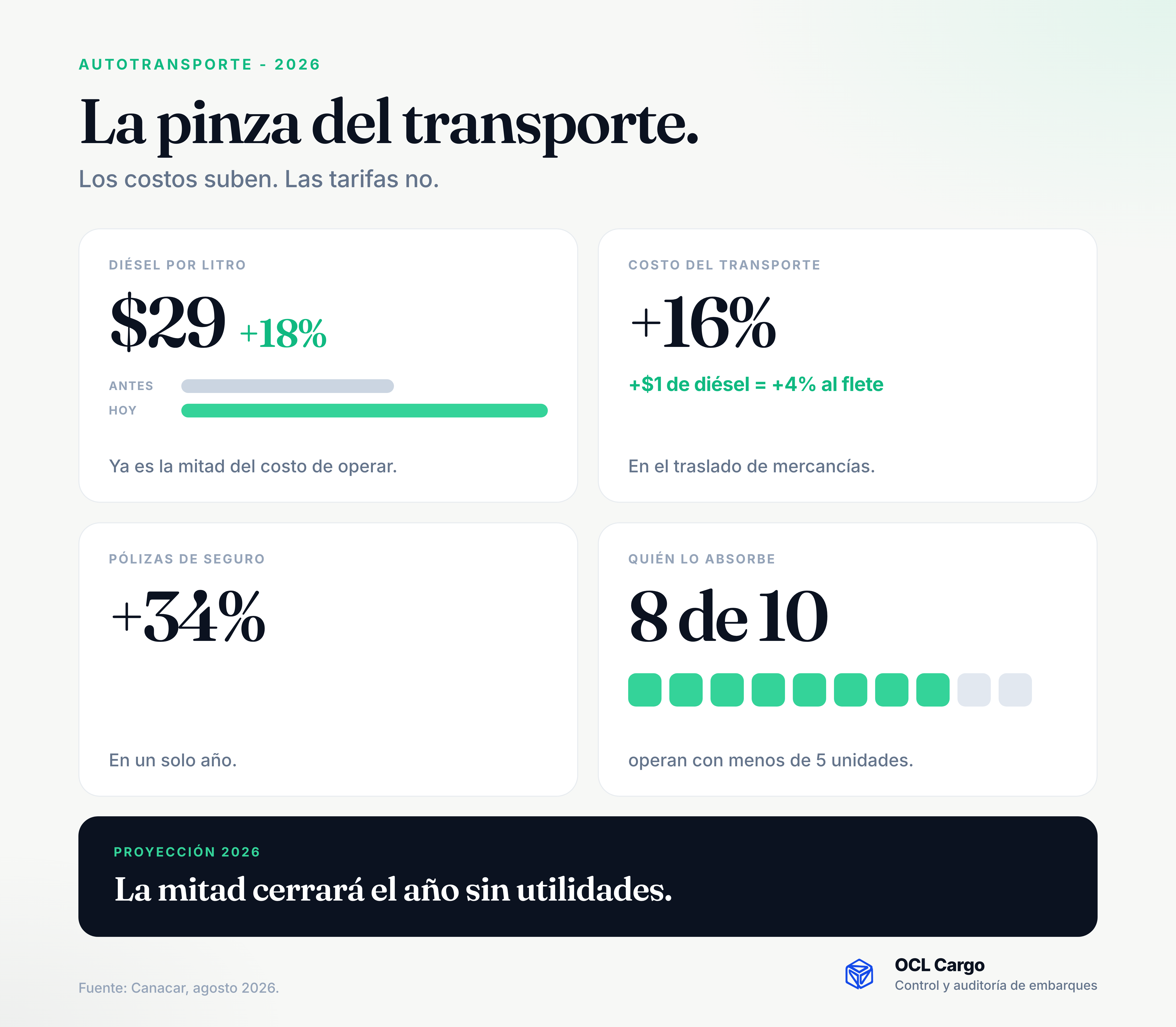
The squeeze: diesel, insurance, and rates
Diesel
$29/L
+18% vs ~$22.50. Already more than half of operating cost.
Transport cost
+16%
Industry rule: +$1 diesel ≈ +4% freight.
Insurance policies
+34%
In a single year. A fixed cost that will not wait for your budget.
Industry projection
1 of 2
Closes 2026 without profits. 8 of 10 operate with <5 units.
The full picture is brutally simple:
- The cost of moving freight rises
- The rate the customer accepts often does not
- The carrier absorbs. Until they cannot
Industry frame (chamber estimates and press coverage), August 2026.
Infographic: the transport squeeze
The shipper blind spot
Almost nobody on the shipper side wants to see this: when capacity exits the market, survivors set the price. The cheap-freight invoice arrives later-with interest.
Rejecting “temporary” increases feels like winning the negotiation. In reality you are selecting who stays in your network.
Often whoever cuts maintenance, documentation, or insurance… until they leave you stranded in peak season.
If your operation lives in Excel and WhatsApp, you may not even know whether the price you pay is the contracted one. That is where freight audit at 100% and a living rate card beat blind haggling.
The smart game: pay exact
The smart game is not paying less for freight. It is paying exact: contracted, evidenced, and fast to the carrier you want still operating next year.
- Contracted - lane rate + authorized accessorials. Not a peso more for invented detention; not a peso less by squeezing someone who performed.
- Evidenced - POD, Carta Porte, GPS/geofence, CFDI. Without a file, endless disputes and carriers who stop prioritizing you.
- Fast : the small operator’s cash cycle is what the industry is describing. Paying in 60–90 days “because it has always been that way” is another way to finance their exit.
Are you negotiating rates… or financing the disappearance of your own capacity?
In a published 3PL case, moving from sampling to 100% matching found $3.6M MXN in 6 weeks - not by squeezing good carriers, but by stopping payment for unsupported charges. That is the difference between saving money and destroying the network.
Checklist: do not finance your own scarcity
Elige un paso para ver el detalle
Detalle del paso · 01
Freeze a rate card by lane and mode
Overpaying… or destroying capacity by paying “cheap”?
In 48 hours we review invoice leakage and rate/payment discipline on your real operation, not generic slides.
Book a demoKey takeaways5 points
- Diesel moved from ~$22.50 to ~$29/L (+18%) and is already more than half the cost of running a truck.
- Insurance +34% in one year; transport cost up to +16%. Industry rule: +$1 diesel ≈ +4% freight.
- Industry projections estimate half of Mexican trucking will close 2026 without profits.
- When capacity exits, survivors set the price. Cheap freight is collected later, with interest.
- The smart game is not paying less: it is paying exact: contracted, evidenced, and fast to carriers you want to keep.
Frequently asked questions
Industry estimates for Mexican trucking say with rising costs and rates that do not keep up, the projection is that half of Mexican trucking will close 2026 without profits. Diesel, insurance, and refused rate adjustments form the “squeeze.”
Diesel moved from about $22.50 to about $29 per liter (+18% in the cited arc). It already accounts for more than half of the cost to run a truck. A common industry rule of thumb: every peso diesel rises, freight can rise ~4%.
Because capacity that runs at zero or negative margin exits the market. Survivors concentrate pricing power. Today’s “cheap” freight is collected later with interest: fewer options, worse SLAs, and more expensive spot.
Pay what was contracted (rate + authorized accessorials), with evidence (POD, Carta Porte, GPS, CFDI), and fast to the carrier you want still around next year - neither reflexive haggling nor overpaying for lack of audit.
Tendering, track & trace, and audit agents quote with evidence, alert exceptions, and match 100% of invoices to contracted rates before payment. You defend spend without starving the capacity you need.