

Definition
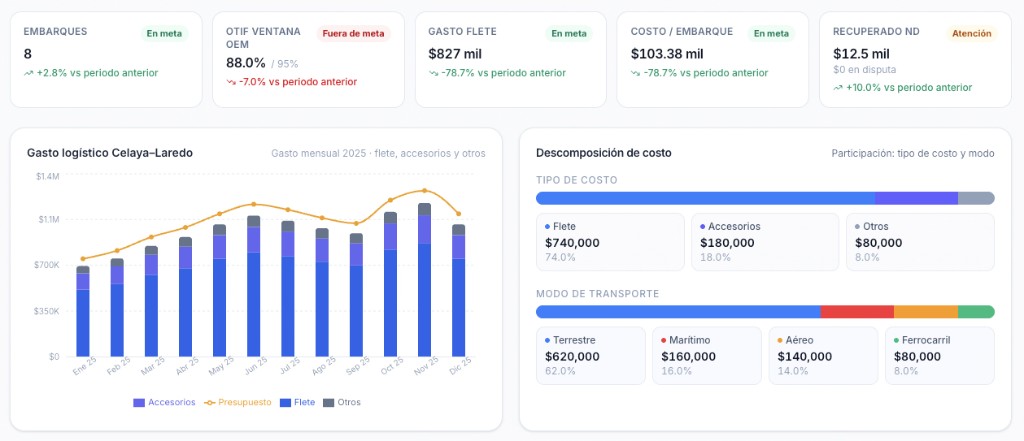
OCL Cargo’s tower module («Tower: exceptions and recovery») concentrates on-time performance, cost per shipment, and freight recovered so the team decides on exceptions already diagnosed — not capture by hand in a parallel spreadsheet.
If the tower pastes WhatsApp into Excel, you have capture disguised as control. The landing Tower module shows what matters: on-time, cost, and recovery, with exceptions ready.
What the exceptions & recovery tower means in practice
Not another disconnected BI: it is the decision layer on the file execution agents already built. The team prioritizes holds, deviations, and disputes.
Recovered % links to the audit agent and the 3PL case (5.7%).
Why it matters (shipper / 3PL / leadership)
1.Tower / operations
Exception queue with diagnosis, not a chat list.
2.Finance
Sees freight recovered and cost/shipment in one place.
3.Leadership
Execution KPI (recovered, OTIF) vs vanity TMS logins.
How it works / when it applies
It fits when execution with agents exists (or is piloted) and you need visual governance. If rules and files are missing, the dashboard only paints over chaos.
| Tower KPI | Question | Source |
|---|---|---|
| On-time / OTIF | Did we arrive on time? | GPS + appointments |
| Cost / shipment | What did we really pay? | Rate + audit |
| % recovered | How much bad pay did we stop? | Pre-pay disputes |
Useful tower checklist
1.Exception with owner
Every hold has an owner and SLA.
2.No parallel Excel
Capture lives in the file.
3.Recovery visible
MXN and % of audited spend.
4.Drill-down to trip
From KPI to ID in one click.
Zen flow
Signals
GPS POD audit
Diagnose
Exception
Queue
Owner acts
KPI
Recovered
Common mistakes
1.Dashboard without a file
Numbers that do not drill to the trip.
2.Measuring TMS logins
Does not measure finished work.
3.Alerts without owners
Noise nobody closes.
OCL and the shipment file (light)
OCL tower is the decision face of the autonomous TMS. Full map: freight agents.
Sources and further reading
- Case: 3PL audit agent.
- Glossary: control tower.
- Audit: audit agent.
- Hub: freight agents.
Key takeaways5 points
- Landing analytics: diagnosed exceptions, recovery in view, no capture Excel.
- Demo KPI: on-time, cost/shipment, and ~5.7% recovered.
- Does not replace control tower as a concept: it changes work from capture to decision.
- Fed by assignment, GPS, POD, and audit on the same file.
- Hub: freight agents.
Is your tower watching KPIs or still typing status?
Frequently asked questions
The landing layer where the team sees on-time, cost per shipment, and freight recovered, and acts on exceptions already diagnosed — not typing status by hand.
It is the product analytics/tower module fed by execution agents. Decisions stay human.
From 100% audit patterns; the 3PL case documented 5.7% / $3.6M MXN in 6 weeks.
It changes the work: from human bridge to exceptions. Concept: control tower.
Tower on-time crosses the SLA/OTIF agent (beta) and GPS/POD.