

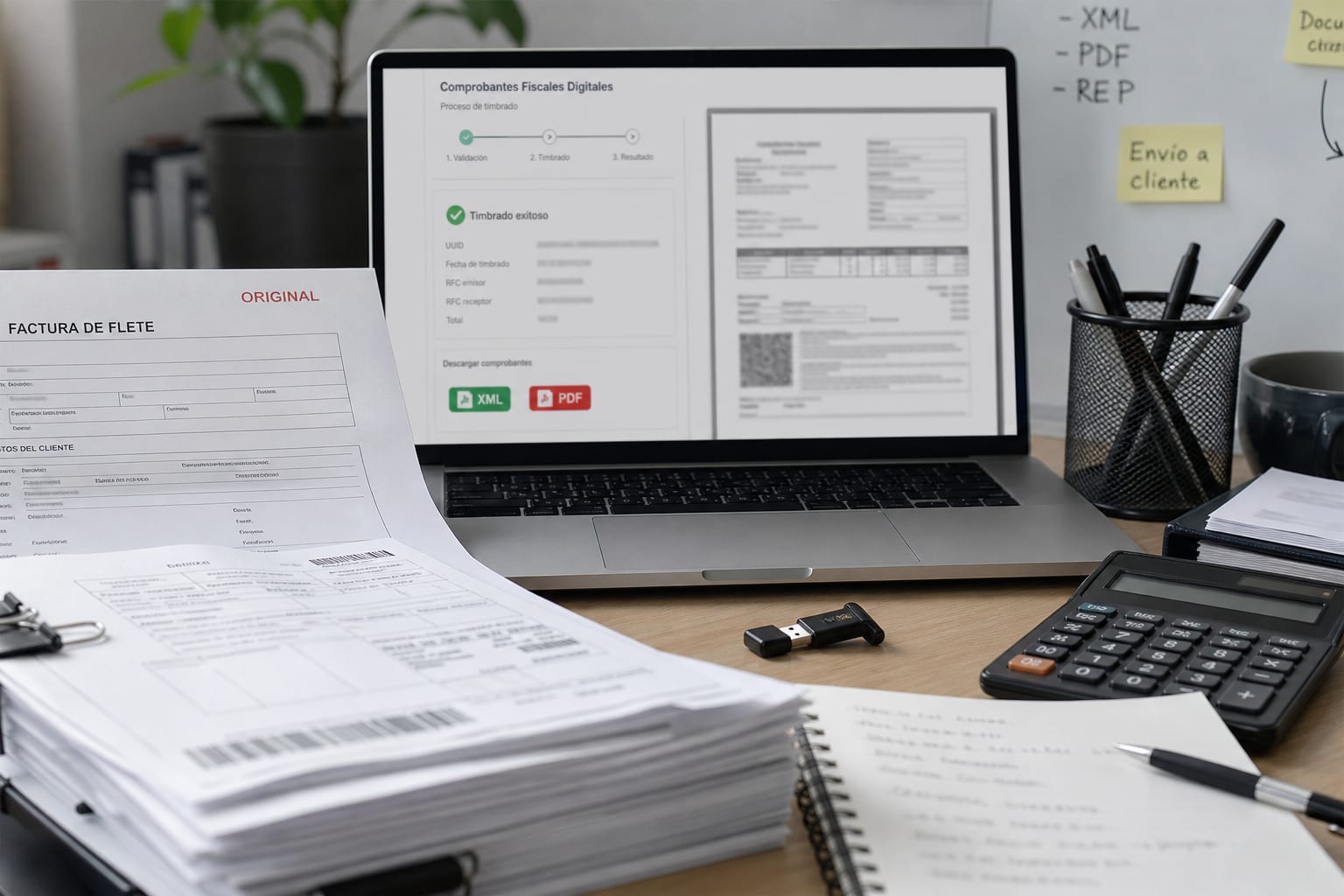
A Proveedor Autorizado de Certificación (PAC) / Authorized Certification Provider is the SAT-authorized entity that certifies and stamps Mexican electronic tax vouchers (CFDI): it validates the XML, applies the digital seal, and returns the tax folio (UUID). On Mexico–U.S. freight, the carrier (or its system) builds the voucher · with Carta Porte complement when applicable · and the PAC applies the seal; the shipper or 3PL verifies the XML before paying.
If your RFP asks the shipper TMS to “be a PAC,” you are buying the wrong role. Money leaks when accounts payable confuses stamping with auditing the trip file.
- seal + UUID for the SAT
- Stamp
- rate · POD · accessorials
- ≠ audit
- official count (not viral)
- SAT list
- XML + CP + evidence
- Trip file
Cluster: CFDI stamping · UUID · CFDI XML · Carta Porte · pre-pay validation · Mexico freight tax.
What a PAC is (usable answer)
The PAC is tax-certification infrastructure: it receives the voucher built by the issuer (or its software), applies SAT rules and catalogs, and returns the stamped CFDI with UUID. It does not quote freight, match geofences, or release payments.
Typical transport flow: carrier (or ERP/TMS) builds the XML, PAC stamps, and buyer stores XML/UUID on the trip file. Issuance detail: income CFDI in transport and Carta Porte 3.1 complement.
PAC
- Validates SAT structure and catalogs
- Applies seal and UUID folio
- Leaves the CFDI ready for tax effects
Buyer
- Matches rate / confirmation
- Reviews complement, GPS, and POD
- Decides pay, hold, or exception
What the PAC does (and does not)
Separating roles prevents broken RFPs and endless disputes between traffic, tax, and accounts payable.
| Role | Does | Does not |
|---|---|---|
| Carrier (issuer) | Builds CFDI / Carta Porte from trip data | Audit the shipper’s payment |
| PAC | Certifies, stamps, and returns UUID | Match rate, geofence, or POD |
| Shipper / accounts payable | Verifies XML and pre-pay file | Stamp the carrier’s CFDI |
| OCL | Can stamp; also matches the trip file | Guarantee deductibility or a tax opinion |
PAC vs software vs free SAT portal
Not every “invoicing system” is a PAC. Many apps call an authorized PAC behind the scenes; the SAT portal covers free issuance for limited volumes and profiles. Calibrate with your operation · not the vendor slogan.
PAC
What it is: Authorized entity that certifies/stamps
When it fits: Recurring issuance, API, high volume
Typical limit: Does not audit freight or release pay
Invoicing software
What it is: UI or ERP that builds XML and calls a PAC
When it fits: Fleets and firms with daily issuance
Typical limit: Without a live PAC behind it, no valid CFDI
Free SAT portal
What it is: Direct issuance on the SAT site
When it fits: Low volume / simple cases
Typical limit: Impractical for mass freight + Carta Porte
PAC and CFDI types in freight
On the corridor, the PAC stamps the voucher the issuer builds. What changes risk for accounts payable is the type and whether a complement is required.
Income
Freight use: Billing the transport service (freight invoice)
What to check pre-pay: Amount vs rate · receiver · Carta Porte complement if due
Transfer
Freight use: Goods movement without freight charge on that voucher
What to check pre-pay: Goods/location nodes · coherence with the trip
Egreso (credit)
Freight use: Credit notes / adjustments on freight
What to check pre-pay: Related UUID · reason · do not double-pay the trip
Frame guide: 2026 transport invoicing. The PAC does not “choose” the type for you: if the XML is wrong at birth, the seal does not turn it into a freight audit.

How it applies on Mexico–U.S.
On Mexico–U.S. trucking the tax anchor is usually the CFDI with Carta Porte plus operating evidence (appointment, GPS, POD). The U.S. leg may live in another document pack; the Mexican PAC does not “seal” the Bill of Lading.
- Who issues: almost always the carrier (or the owner, depending on the move type) via its PAC.
- Who verifies: shipper / 3PL / accounts payable before releasing payment · see pre-pay validation.
- Cancellations: there are deadlines and receiver-acceptance rules under the SAT’s published rules. Do not pay a canceled or disputed UUID · calibrate with the current rule (do not memorize a vendor blog’s “72 hours”).
- Accessorials: detention, redelivery, false freight · without XML/UUID or a rate match, accounts payable has no support.
Stamping and pre-pay process
From XML build to payment there are two halves: certify (PAC) and verify (buyer). Stamping closes the first; the second lives in the trip file.
Build XML
Trip data
Send to PAC
SAT validation
Receive UUID
Stamped CFDI
Store on trip
XML in file
Match pre-pay
Rate · CP · POD
How to choose a PAC (SAT checklist)
Vendor blogs sell “the best PAC.” A serious decision starts with the official SAT authorized-providers list and fitness for your Carta Porte flow · not a viral headcount (~51 vs ~77).
Elige un paso para ver el detalle
Detalle del paso · 01
Live on the SAT list
Expensive mistakes
Elige un paso para ver el detalle
Detalle del paso · 01
Requiring the shipper TMS to “be a PAC”
OCL and the trip file
OCL Cargo is an autonomous TMS with agents that operate screens and portals: they bind rate, CFDI/UUID, Carta Porte complement, and proof of delivery (POD) in the trip file before pay. It coexists with your system of record on day one.
OCL can stamp invoices and Carta Porte when your stack needs it. It is not a “hire our catalog PAC” pitch: the edge is pre-pay matching and exception tower. Who owns exceptions? Your team. Typical pilot 6–8 weeks; recovery pattern 5–7% when auditing 100% of the pilot flow · pricing signal from ~$50 MXN per shipment by scope.
Key takeaways6 points
- PAC = who stamps the CFDI for the SAT · not your freight auditor or rate card.
- In transport: the carrier (or its system) builds the XML; the PAC seals; the shipper verifies before pay.
- Stamping ≠ auditing: a valid UUID does not prove rate, geofence, or POD.
- In freight watch type (income/transfer), Carta Porte complement, and UUID on the trip ID.
- How many PACs: calibrate with the official SAT list · not a vendor blog count (~51 vs ~77).
- OCL joins the pre-pay file and can stamp invoices and Carta Porte; it is not a “be your PAC” pitch.
Do stamping and audit live in different files?
Related reading
Frequently asked questions
A Proveedor Autorizado de Certificación (PAC) / Authorized Certification Provider is the SAT-authorized entity that certifies and stamps Mexican electronic tax vouchers (CFDI): it validates structure/catalogs, applies the digital seal, and returns the tax folio (UUID).
OCL is an autonomous transportation management system (TMS) with AI agents · not a catalog e-invoicing SaaS. It can stamp invoices and Carta Porte when your stack needs it; its edge is matching the trip file (rate + CFDI + Carta Porte + proof of delivery) before pay.
For the carrier’s freight CFDI, no: the issuer’s PAC stamps it. The shipper still must store and validate the received XML on the trip file before releasing payment.
No. UUID and SAT status are necessary but not sufficient: accounts payable must match rate, CFDI type, Carta Porte complement when due, GPS, and proof of delivery (POD).
The number changes (authorizations, revocations, withdrawals). Vendor blogs cite different ranges (~51–77). The official source is the SAT authorized-providers list; do not memorize a viral headcount.
The Carta Porte complement travels in the same CFDI the PAC stamps. A valid UUID does not guarantee correct goods, locations, or figures · that is audited in the trip file.
SAT rejection, a CFDI without a usable UUID, carrier collection delays, and holds in accounts payable. Accessorials without XML/UUID lack defensible tax support. Tipify the exception; do not pay “on trust.”