

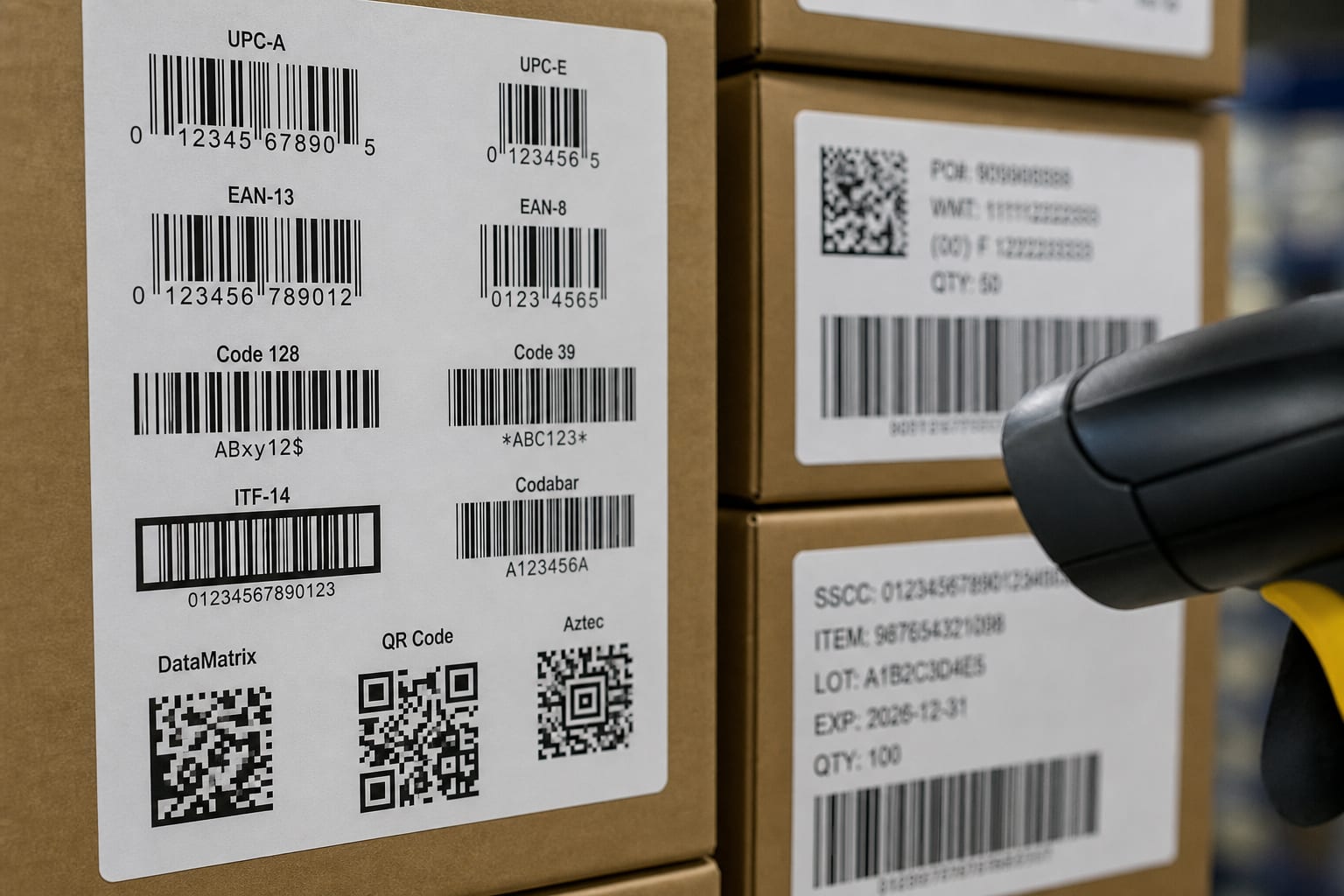
A barcode is the graphic representation of data a scanner reads to identify a product, carton, pallet, or shipment. In a Mexico–U.S. corridor CEDIS it is not just “for marketplace listings”: it anchors inventory, trip release, and freight trip-file events.
This guide answers what it is, what it is not (ClaveProdServ · POD · misused GTIN), 1D vs 2D, the types that matter on the floor and in freight, when to use each, and how scanning feeds the trip · not only the retail listing.
- families you must distinguish
- 1D · 2D
- SKU · carton · pallet · shipment
- 4 levels
- typical recovery when auditing 100%
- 5–7%
- pilot without a WMS big-bang
- 6–8 wk
Cluster context: what is inventory · what is a SKU · SAT ClaveProdServ.
What a barcode is
It is a symbol (vertical bars or a matrix of dots/squares) that encodes a machine-readable identifier. The scanner turns the symbol into a number or string; the warehouse management system (WMS), point of sale, or TMS records the event.
In retail, the symbol usually represents a GTIN (Global Trade Item Number) assigned under GS1 standards. In shipper logistics, the same idea applies to larger units: master carton, pallet and, with GS1-128, the SSCC (Serial Shipping Container Code) for the logistics unit.
What it is not: ClaveProdServ, POD, and GTIN myths
Three expensive mix-ups in Mexico. Separating them prevents fiscal rejects, delivery disputes, and dirty master data.
Barcode / GTIN / SSCC
- Identifies the physical or commercial unit
- Scanned at pick, load, or delivery
- May be EAN-13, UPC, GS1-128, QR…
- Feeds WMS, labels, and trip events
What it is NOT
- SAT ClaveProdServ (fiscal catalog · not a barcode)
- Full POD (scan ≠ signature/photo/condition)
- Internal SKU (can map · not the same thing)
- Marketplace ASIN / listing ID
Fiscal detail: ClaveProdServ. Evidence detail: what is POD. Master-data detail: what is a SKU.
Linear (1D) vs two-dimensional (2D)
The first useful decision is not “which looks more modern?”. It is how much data you need, how much label space you have, and what your floor scanners already read.
1D (linear)
What it is: Vertical bars and spaces
Strength: Everywhere in POS and CEDIS; cheap scanners
Typical limit: Few data; damage/dirt can fail reads
2D (matrix)
What it is: QR, Data Matrix (grid)
Strength: More data in little space; robust on small parts
Typical limit: Needs 2D readers; not every dock gun is ready
GS1 Mexico communicates a retail shift toward 2D codes (including 2D versions in its issuance ecosystem). Confirm current status with GS1 Mexico · do not assume your dock already reads 2D on 100% of guns.
Types that matter in CEDIS and freight
Ecommerce and GS1 retail blogs list EAN, UPC, Code 128, and QR. For corridor shippers, prioritize what moves pick, load, and the logistics unit · not only the listing.
EAN-13
Typical level: SKU / item
MX–US corridor use: Mexico retail and export; checkout and inventory
Warning sign: Unregistered GTIN or duplicates across variants
UPC-A
Typical level: SKU / item
MX–US corridor use: U.S./Canada POS; map to EAN in the master
Warning sign: Two masters without MX↔US equivalence
Code 128
Typical level: Carton / shipping
MX–US corridor use: Dense shipping labels, alphanumeric
Warning sign: Illegible dock label or no trip ID
GS1-128 + SSCC
Typical level: Master carton / pallet
MX–US corridor use: End-to-end logistics unit; lot/expiry AIs
Warning sign: Pallet without SSCC · fight at receipt and claim
ITF-14 / GTIN-14
Typical level: Grouped pack
MX–US corridor use: CEDIS cases / retail receiving
Warning sign: Case with no ID · only loose-piece EAN
QR
Typical level: Item / link
MX–US corridor use: GS1 Digital Link, apps, extended info
Warning sign: QR with no useful WMS data (marketing only)
Data Matrix
Typical level: Part / regulated
MX–US corridor use: Minimal space; healthcare and small parts
Warning sign: Floor without calibrated 2D readers
When to use each: SKU, carton, pallet, shipment
Use this matrix before buying labels or arguing with the carrier. The classic error is putting only a piece-level EAN on a pallet and expecting shipment traceability.
SKU / piece
Typical symbol: EAN-13 or UPC
When: Sale, each-pick, cycle count
Risk if missing: Blind inventory · retail chargebacks
Carton / package
Typical symbol: Code 128 or ITF-14
When: Case pick, LTL consolidation
Risk if missing: Mixed destinations · bad load
Pallet / logistics unit
Typical symbol: GS1-128 (SSCC)
When: Full or consolidated shipment
Risk if missing: Blind receipt · claim with no ID
Shipment / trip
Typical symbol: SSCC + trip ID in TMS
When: Load, transit, delivery
Risk if missing: Broken trip file · POD does not tie
Dense / regulated data
Typical symbol: Data Matrix or GS1 QR
When: Lot, expiry, digital link
Risk if missing: Incomplete recall traceability
Cargo types and how you store them change the label: warehouse cargo types.
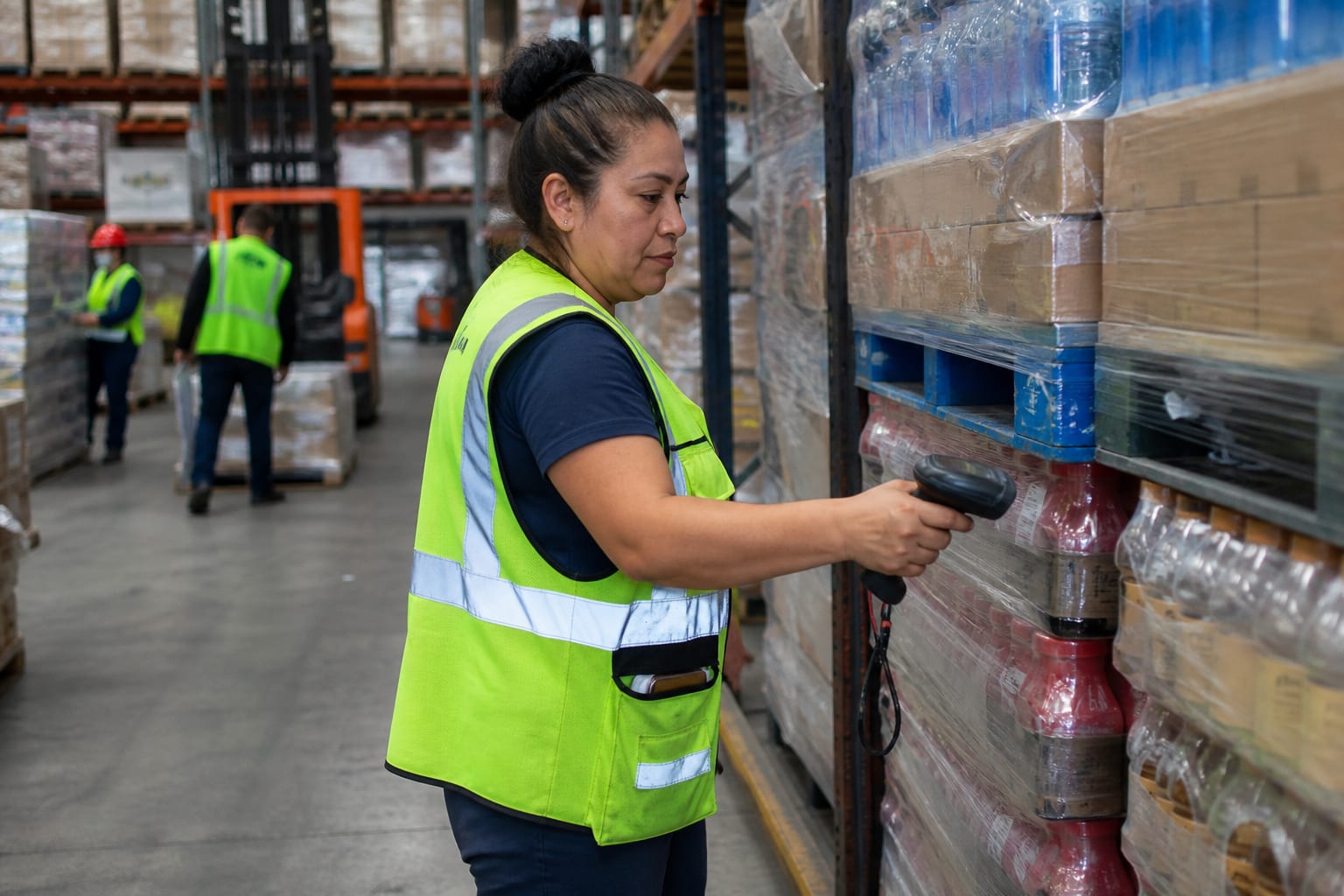
Scan at pick, load, and delivery into the trip file
The gap versus ecommerce/GS1 retail blogs is this: the symbol only pays off if it creates events tied to the trip ID. Three minimum moments on the corridor.
Events
Three scans that matter
Pick
SKU or carton
Load
Pallet / SSCC
Delivery
Event + POD
At pick: confirm what left. At load: confirm which logistics unit went on the trailer. At delivery: record the event; defensible POD adds signature, photo, or condition when the contract requires it. Without that, OTD and accounts payable fight blind.
GS1 Mexico and GTIN (no invented prices)
In Mexico, GS1 Mexico administers membership and GTIN assignment under GS1 standards for trade. Chains and many marketplaces require valid GTINs · not “free generator” codes that collide.
Cost ties to membership / GTIN range, not “one barcode by the kilo”. We do not publish fee tables here: they change and depend on company size. Confirm amounts and process on the official GS1 Mexico site. If someone sells “unlimited codes” at a unit price without membership, treat that as an operational risk signal.
For the shipper: even with a perfect GTIN, without SSCC on the pallet and without a load scan, freight stays blind. Retail listing ≠ trip file.
Labeling and scanning checklist
Use this list on Monday before releasing a critical trip. If you fail two or more items, the problem is not “missing a pretty QR”: it is identity control.
Elige un paso para ver el detalle
Detalle del paso · 01
Clean master
Check 1
OCL ties scans to the trip file (without replacing WMS)
OCL Cargo is an autonomous TMS with computer use agents: the agent operates screens (portals, email, PDFs) like your control tower and leaves a trip file. It does not replace the WMS or guns on day one · it complements once the pallet has left and freight must reconcile.
When auditing 100% of the pilot flow (rate + CFDI + Carta Porte + GPS + POD), the published pattern is recovering 5–7% of audited spend. Typical pilot 6–8 weeks · about ~$50 MXN per shipment. Who decides exceptions? Your team.
Post-scan
From beep to pay
Capture event
Pick / load / delivery
Cross docs
CFDI and Carta Porte
Validate route
GPS and geofence
Tie POD
More than a beep
Pay or hold
With trip file
OCL can stamp invoice and Carta Porte. More context: false digitization · computer use in logistics.
Key takeaways5 points
- Barcode = scannable symbol that identifies SKU, carton, pallet, or shipment · not ClaveProdServ and not full POD.
- 1D (EAN/UPC, Code 128, GS1-128) vs 2D (QR, Data Matrix): choose by logistics level and what your floor already reads.
- On MX–US freight, prioritize EAN-13/UPC (item), Code 128 (shipping label), GS1-128/SSCC (logistics unit), and 2D when density or regulation requires it.
- Pick, load, and delivery scans are trip-file events · a delivery beep does not replace defensible POD.
- OCL does not replace WMS/scanners: it closes the trip with evidence · your team decides exceptions · 6–8 week pilot · 5–7% pattern.
Do your codes identify the listing… while freight stays blind?
Related reading
Frequently asked questions
A graphic symbol (bars or a matrix) that a scanner reads to identify a SKU, carton, pallet, or shipment. In Mexico–U.S. CEDIS and freight it is not packaging decoration: it is the event that feeds inventory, loading, and the trip file.
Linear (1D): EAN-13, UPC, Code 128, GS1-128. Two-dimensional (2D): QR and Data Matrix. 1D identifies with few digits; 2D stores more data in less space. The useful decision is which level you identify (SKU · carton · pallet · shipment).
EAN-13 (13 digits) is the most common consumer-product standard in Mexico and global retail. UPC-A (12 digits) dominates U.S. and Canada POS. Both carry an item GTIN; on the MX–US corridor, map equivalences in the master data instead of inventing a second “ghost” code.
Code 128 is a dense linear symbology for shipping labels and alphanumeric data. GS1-128 is Code 128 with GS1 Application Identifiers: lot, expiry, quantity and, in logistics, the SSCC (Serial Shipping Container Code) that identifies the logistics unit (master carton or pallet) end to end.
QR is ubiquitous in apps and links (including GS1 Digital Link). Data Matrix is compact and robust on small or regulated parts (e.g. healthcare). On the CEDIS floor, the winner is what your scanners and WMS already read at high rate · not the “newest” pamphlet option.
No. A barcode identifies the physical/commercial unit (GTIN or other ID). ClaveProdServ is the SAT catalog key for invoicing / Carta Porte. Confusing them breaks CFDI. See ClaveProdServ.
Not alone. A delivery scan is a useful event, but defensible proof of delivery (POD) usually needs who, when, what, and condition (signature, photo, geo when required) tied to the trip ID. See what is POD.
No. The warehouse management system (WMS) and scanners still own pick and location. OCL is an autonomous TMS with agents: it ties scan events to the trip file (rate, CFDI, Carta Porte, GPS, POD). Who decides exceptions? Your team. Typical pilot 6–8 weeks · 5–7% pattern · ~$50 MXN/shipment when it fits. OCL can stamp invoice and Carta Porte.