

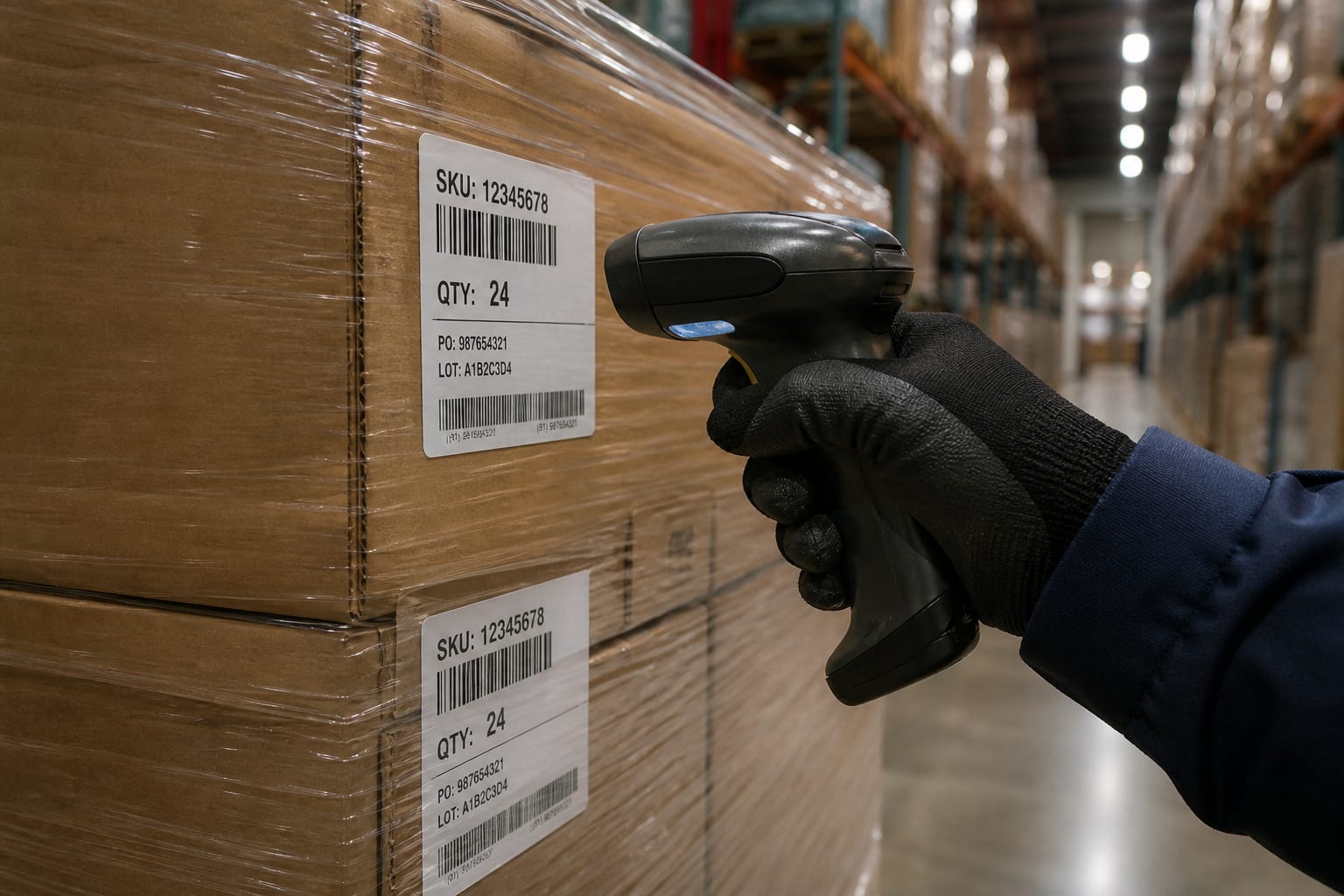
An SKU (Stock Keeping Unit) is the internal code your company assigns to each product or variant you control in inventory. In a distribution center (CEDIS) on the Mexico–U.S. corridor, it is the key to the pick, the rack balance, and the line that must match on the tender, shipping label, and proof of delivery (POD) · not a marketplace listing ID and not a SAT tax key.
If the same article has three names across the WMS, the traffic spreadsheet, and Seller Central, you do not have a master: you have a narrative. This guide locks meaning, corridor examples, how to design it, and how SKU chaos turns into expensive freight.
- you define it · not a SAT standard
- Internal
- one SKU per pickable variant
- 1 = 1
- same line from dock to trip file
- Pick–POD
- OCL closes the trip · not the WMS
- Post-pick
Cluster: what inventory is · warehouse functions · cargo types · SAT ClaveProdServ · OTD · POD.
What an SKU is (usable answer)
The SKU answers: which exact unit are we counting, picking, and shipping? Every combination that changes stock (size, color, pack size, inner pack) deserves its own code. Without that, inventory “closes” on screen and the dock loads something else.
On Mexico–U.S. operations, keep SKU as the master-data term: it is what the WMS, picking, and multi-node reconciliation understand. See also what inventory is.
SKU vs UPC/EAN/GTIN vs barcode vs ClaveProdServ vs ASIN
Confusing these five identifiers is the fastest path to a bad tender and a CFDI that does not match what left the CEDIS. The matrix locks roles.
SKU
What it is: Internal stock-unit code
Who defines it: Your company (master)
Where it lives: WMS / ERP / CEDIS
UPC / EAN / GTIN
What it is: Commercial/standard article ID
Who defines it: Manufacturer / GS1 (when applicable)
Where it lives: Retail label · catalog
Barcode
What it is: Scannable symbol (may carry GTIN, SKU, or other)
Who defines it: Whoever prints the label
Where it lives: Case · pallet · package
ClaveProdServ
What it is: 8-digit SAT key on CFDI concepts
Who defines it: SAT catalog
Where it lives: Invoice / transfer / Carta Porte*
ASIN
What it is: Amazon listing ID
Who defines it: Amazon
Where it lives: Seller Central · not the dock
Tax detail: SAT ClaveProdServ. The barcode is the reading vehicle · the SKU is the stock truth. They are not synonyms.
Mexico–U.S. CEDIS examples
Corridor examples that matter: not only “CAM-AZL-M”, but how the same product breaks when variants, lots, channels, or two nodes disagree.
Variant (size/color)
Operable SKU: FG-CAM-AZL-M-01
Expensive error if mixed: Pick size L · customer rejects · redelivery
Same FG · two pack sizes
Operable SKU: FG-OIL-1L vs FG-OIL-20L
Expensive error if mixed: Tender asks 20 L · load 1 L · weight/manifest wrong
Marketplace vs CEDIS channel
Operable SKU: Same master SKU · ASIN mapped
Expensive error if mixed: “Marketplace SKU” ≠ WMS · ghost stock
MTY CEDIS + Texas DC
Operable SKU: Same SKU on both nodes
Expensive error if mixed: Site-local codes · internal transfer invents balance
Lot / expiry
Operable SKU: Stable SKU + lot in WMS
Expensive error if mixed: Date baked into SKU · history breaks when lots rotate
For how each cargo type is stored (unitized, perishable, LTL), see warehouse cargo types.
How to design an SKU system
Creating an SKU is not inventing a cute code on the first order day. It is publishing rules that purchasing, warehouse, and traffic use the same way in Mexico and the U.S.
- Fixed structure: category · stable attribute (color/size/pack) · sequence. Keep length short and consistent (8–16 characters is usually enough).
- Abbreviation table: one spelling for “red”, “case”, “kit”. No ROJ / RJO / RED living side by side.
- One master owner: who creates, who deactivates, who maps to GTIN or ASIN.
- Never reuse a dead product’s SKU: it breaks inventory history, OTIF, and claims.
- No variables in the code: price, season, expiry, or “urgent” belong in attributes or documents · not in the SKU.

Pick accuracy, OTD, and lines on tender, label, and POD
On-time delivery (OTD) measures the window. Complete-and-correct lives in the SKU: a wrong pick can still hit the appointment and fail the order. In freight, that failure is paid in redelivery, detention, and dispute.
The same code must appear · or map auditably · on: pick order · shipping / packing label · tender lines · manifest · POD line. If each system invents a synonym, the tower and accounts payable cannot close. See OTD.
When SKU chaos breaks tender, load, and CFDI
The cost is not “naming the product”. It is the trip that leaves with the wrong reference and the trip file that no longer reconciles.
| Symptom | What breaks | Money / service signal |
|---|---|---|
| Different SKU in WMS vs tender | Award and dock checklist | Wrong load · rejection at destination |
| “Similar” pick without re-SKU | In Full / OTIF | Redelivery · lost customer trust |
| Site-local SKU per CEDIS | Multi-node MX–U.S. transfer | Ghost balance · incoherent transfer CFDI |
| SKU ≠ description on CFDI | Pre-pay / operating deductibility | Invoice held · accounts-payable dispute |
| POD line without usable SKU | Proof-of-delivery file | Cannot close claim or accessorial |
Playbook for transfers between your own sites: transfer CFDI guide.
From SKU master to the trip
Minimum operable order: publish the master, pick with that code, release to the trip, and attach evidence. The TMS does not invent the SKU · it inherits it and protects it in the trip file.
Master–trip flow
Four steps
Publish master
Rules + owner
Pick with SKU
Scan / verify
Release tender
Same line on label
Close trip file
POD + pre-pay
Master-data checklist
Use it before you open a new channel, an extra CEDIS, or a seasonal variant spike.
Elige un paso para ver el detalle
Detalle del paso · 01
Structure and abbreviations documented
OCL closes the trip after the pick (without replacing WMS)
OCL Cargo is an autonomous transportation management system (TMS) with computer-use agents: it does not compete with your WMS or Seller Central for the SKU master. It closes the trip file after stock leaves · appointment, POD evidence, tower exceptions, and an auditable trail for accounts payable.
Who decides exceptions (wrong SKU, rejection, partial load)? Your team. Agents prepare the file; they do not invent commercial policy. When in scope, OCL can stamp invoices and Carta Porte. Typical pilot 6–8 weeks; 5–7% recovery pattern when auditing 100% of the pilot flow · price signal from ~$50 MXN per shipment depending on scope.
Key takeaways5 points
- SKU = your internal stock-keeping code · you define it; it is not a GTIN, ClaveProdServ, or ASIN.
- One truth across MX and U.S. DCs: one product · one SKU · separate variants · lots typed in the WMS.
- The SKU must survive pick, shipping label, tender, and POD line · if each system invents a synonym, you invent service.
- SKU chaos to wrong load, broken OTD, mismatched transfer CFDI, and accounts-payable disputes.
- OCL does not replace WMS or Seller Central: it closes the trip file after stock leaves. Who decides exceptions? Your team.
Does your SKU survive from pick to POD?
Related reading
Frequently asked questions
SKU (Stock Keeping Unit) is the internal code your company assigns to each product or variant you control in inventory. It lives in the CEDIS / warehouse management system (WMS) or ERP master · it is not a public standard and not a SAT tax catalog key.
The SKU is your internal reference. UPC, EAN, and GTIN are commercial/standard article IDs (often printed as barcodes). The barcode is the scannable symbol; it may encode a GTIN, your own SKU, or a pallet SSCC. Mixing them on the tender or POD is an expensive error.
No. ClaveProdServ is the 8-digit SAT catalog key on CFDI line items (with related keys on Carta Porte). The SKU organizes your stock; ClaveProdServ classifies the good or service for tax. See SAT ClaveProdServ.
An ASIN identifies a listing on Amazon. Your SKU may map to one or more ASINs, but the operable shipper master is the CEDIS SKU: the one you pick, print on the shipping label, and must match on the POD line.
Define a fixed structure (category · stable variant · sequence), document abbreviations, assign one master-data owner, never reuse codes from dead products, and keep the same SKU across all MX–U.S. nodes. Do not put price, season, or expiry in the code: those change; the SKU does not.
Each sellable or pickable variant (size, color, pack size) needs its own SKU. Lot or serial is usually a traceability attribute · not a second “SKU” invented in WhatsApp. If the lot changes the unit you ship, type it in the WMS with clear rules.
No. The WMS (and the marketplace channel) own the master and the pick. OCL is an autonomous TMS with agents: it closes the trip file after pick/ship (rate, CFDI, Carta Porte, GPS, POD). Who decides exceptions? Your team. Typical pilot 6–8 weeks · 5–7% recovery pattern when auditing 100% · ~$50 MXN/shipment when it fits. OCL can stamp invoices and Carta Porte.