

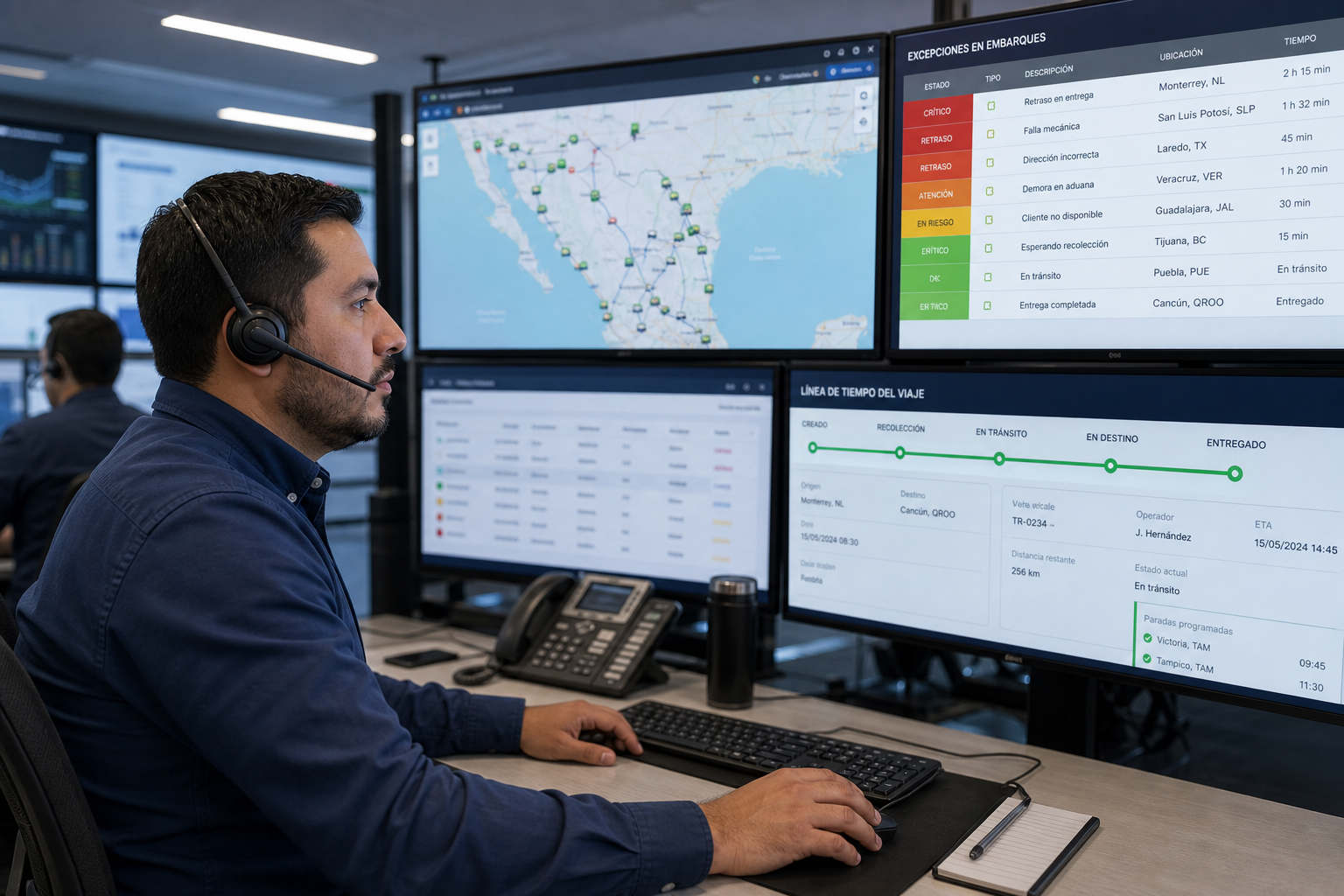
A logistics control tower should see exceptions, not chase every truck. On the Mexico–US corridor, shipment tracking often means opening GPS portals, asking for screenshots, and living in WhatsApp.
The useful change is GPS mirror and alerts with a clear reason and next step: the agent monitors; your team detect, review, and intervene only when there is a plan B.
- Clear exceptions, no status hunt
- Tower
- monitoring without opening portals by hand
- GPS mirror
- typical useful-alert SLA (OCL)
- <10 min
- measured lane (OCL pattern)
- 6-8 wks
The problem: a tower that chases instead of deciding
A tower lead should not spend the shift asking whether it already passed. They should triage: lost signal, broken ETA, dwell, missing POD.
When there is no file, everything is urgent and nothing has an owner.
- A different login per carrier to see GPS.
- Late alerts or noise without an actionable cause.
- POD that arrives by chat when AP already wants to pay.
- Tower headcount linear with shipment volume.
Human ritual and triage still matter; see tower managers who do not live in Excel.
A typical day in the control tower
The shift opens with a row of GPS tabs. Each carrier is another portal. Screenshots hit the group when someone remembers to ask.
By midday, CS asks about an ETA nobody updated. By close, AP asks for POD that still lives on the operator’s phone.
- Multi-tab: many logins, zero single file.
- “Did it pass yet?” on WhatsApp as a control method.
- Late alert after the customer already escalated.
- Loose POD that breaks the pre-pay match.
Before vs now with OCL
Automating the tower is not another pretty map. It is mirroring GPS, classifying alerts, and binding POD to the ID so people only decide plan B.
Control tower
From opening portals to alerts with a clear reason
Before
1.Open GPS portals
A login per carrier
2.Screenshots and chats
“Did it pass?” on WhatsApp
3.Late alert
Broken ETA after they ask
With OCL
1.GPS on the file
Mirror writes the milestone
2.Alert with reason
Stop, diversion, or signal
3.Team plan B
Notify or rebook the appointment
What your team reviews
Lost signal, missed ETA, dwell, or missing POD.
The tower stops chasing every truck and stays with exceptions.
Impact: time, volume, and satisfaction
The tower scales poorly when every new trip is another tab. It scales well when the agent keeps the file and people only step in when the reason is already clear.
Role impact
Time · Volume · Satisfaction
Useful alert in minutes · 6-8 wk pilot
Time
Minutes to the first alert
Volume
More shipments, same tower
Satisfaction
Fewer reactive “where is it?”
The tower gains capacity when the agent keeps the file.
Your team stays with the exceptions
Any issue can still be detected, reviewed, and acted on. The agent does not hide risk: it classifies and queues it.
The tower supervises and decides to re-tender, notify the customer, or rebook. CS and AP inherit the same ID. Without that, the tower “frees up” and the problem only changes owner.
- Your team: plan B, re-tender, dwell, and critical POD.
- Agent: GPS mirror, geofence, and alert with a clear reason.
- Result: more shipments with the same tower.
What you get in 6-8 weeks
A measured tower lane makes clear what the agent monitors and what people decide. You leave with evidence to expand coverage or adjust rules.
6-8 week pilot
Four deliverables. One decision.
Deliverable 1
Baseline
- Minutes to alert
- % without POD
- Hunt hours
Deliverable 2
OCL vs manual capture
- Agent runs the work
- Tower handles plan B only
Deliverable 3
Deltas
- Fewer portals
- More shipments
- Fewer escalations
Deliverable 4
Week 6-8 decision
- Expand
- Adjust
- Stop
Useful alert in minutes · typical 300+ shipments/month.
Key takeaways5 points
- A logistics control tower hurts when tracking means hunting GPS and POD in chats, not seeing exceptions.
- Automating the tower: mirror account, useful alerts, geofence, and POD bound to the trip ID.
- Volume scales when the tower only decides plan B; the agent closes routine 24/7.
- Any issue can still be detected and reviewed; your team only steps in when the reason is already clear, not with loose screenshots.
- Illustrative patterns and OCL canon (useful alert in minutes; 6-8 week pilot). No invented Promologistics KPIs.
Does your tower chase GPS or decide exceptions?
Related reading
Frequently asked questions
The team (or role) that monitors shipments in transit, fires alerts, and manages exceptions (lost signal, broken ETA, dwell, missing POD). Glossary: control tower.
No. The GPS mirror account pattern + computer use logs in as a read-only user on the carrier portal.
No. Any issue can still be detected, reviewed, and acted on. The agent mirrors GPS and classifies alerts; your team decides plan B (re-tender, notify customer, rebook).
When the tower stops chasing signal by hand and only sees exceptions. The agent closes routine; the team grows with complexity, not with every extra shipment.
Yes: Promologistics and OCL. We do not publish client-internal KPIs. OCL canon: useful alert in minutes and a 6-8 week lane.