


Definition
In logistics, the Kanban method is a signal that authorizes replenishing material only when it is consumed, not when a calendar pushes stock. That signal is usually a card, an empty container, or a system alert; the column board is the most common visual way to track it.
If your kanban triggers freight expedites every week, you do not have demand-driven replenishment: you have a fire with cards.
Related: inventory · safety stock · just-in-time · WMS · warehouse functions.
What the Kanban method is (definition and origin)
Kanban (看板) means “card” or “visual sign” in Japanese. It emerged at Toyota in the 1950s, driven by Taiichi Ohno as part of the Toyota Production System: replenish like a supermarket, only what the next process already withdrew.
In warehouse and supply chain work, kanban is not “another task board.” It is a demand-driven (pull) replenishment method: consumption fires the authorization to move or make. The board (Backlog, Doing, Done) is the view; the signal is the engine.
It is often mixed up with just-in-time (JIT). JIT is the flow goal (less idle inventory). Kanban is a concrete mechanism to get closer to that goal without pushing stock blindly.
How it works: cards and boards
The cycle is simple: material is consumed, the signal is released, someone acts, and stock returns to the agreed level. If the signal travels without real action (only “updating the chat”), the method breaks.
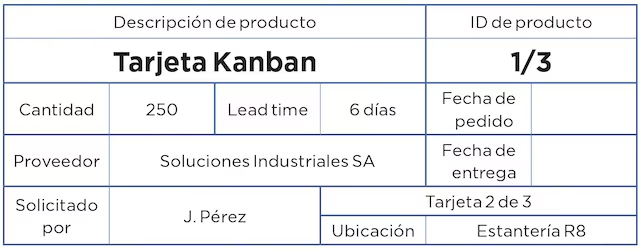
A well-built kanban card answers five questions: which product, how much, in how much time (lead time), who supplies it, and which location receives it. Without those fields, the signal is noise.
The visual board limits work-in-process inventory: only so many signals can sit in “Doing.” That kills fire-drill counting when everyone orders at once.
Visual board
Replenishment kanban
Backlog2
Empty container SKU-A120
Replenishment signal · aisle 4
Stretch film order
2 pallets · ABC
Doing2
Move to dock
Internal replenishment
Laredo pickup
Appointment confirmed
Review2
Validate lead time
Vs safety buffer
Inbound proof of delivery
Evidence pending
Done3
Stock put away
WMS updated
Cycle closed
Shift B
Appointment met
No freight expedite
Kanban types: transport (T) and production (P)
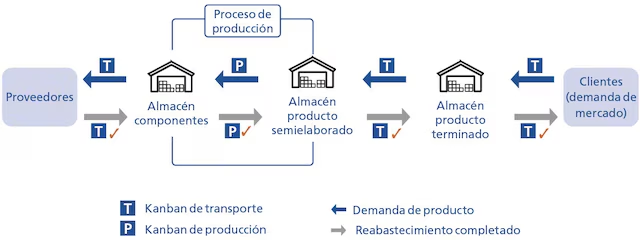
Two classic signals show up in industrial and logistics practice. Transport kanban (T) authorizes moving material from one point to another (supplier to warehouse, warehouse to line, DC to customer). Production kanban (P) authorizes making or transforming when the next process has already consumed.
In a multi-warehouse network, demand “pulls” right to left with T and P signals; material advances left to right when the signal is fulfilled. If you mix T and P without a clear owner, you overbuy or stop the line.
You will also see purchase variants (external supplier), transfers between DCs, and lot signals (replenish only after N empties). The principle does not change: consumption first, authorization second.
Transport (T)
What it authorizes: Move a quantity between locations
Where it shows up: Supplier ↔ warehouse, aisle ↔ dock, DC ↔ customer
Production (P)
What it authorizes: Make or transform a lot
Where it shows up: Line, assembly, packing, kitting
Purchase / supplier
What it authorizes: Order from an external party
Where it shows up: Inbound replenishment with freight lead time
Transfer
What it authorizes: Move between nodes in the same network
Where it shows up: Central DC ↔ satellite or cross-dock
Physical kanban vs e-Kanban
Physical kanban uses cards, empty containers, or floor boards. It is visible, cheap to start, and fragile if cards get lost or consumption is not recorded.
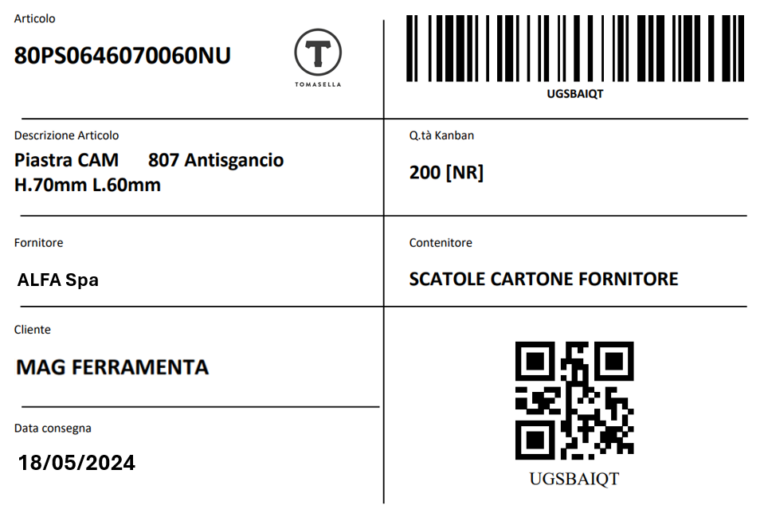
e-Kanban (electronic kanban) digitizes the same signal: scanning a barcode or QR code generates the replenishment alert to purchasing, production, or transport. The label is still “the card”; the scan is the messenger.
The warehouse management system (WMS) is not “kanban”: it executes locations, picks, and confirmations. Kanban defines when and how much to replenish. Together they shrink the human bridge between the floor and the order.
| Criterion | Physical | e-Kanban |
|---|---|---|
| Signal | Card / empty container | Scan event or system threshold |
| Visibility | Local (board / aisle) | Network (DC, purchasing, supplier) |
| Typical risk | Lost or late card | Missed scan or bad master data |
| Fits when | Few SKUs, one node | Many SKUs, multi-node or suppliers |
Advantages and limits
Kanban shines when consumption is relatively stable, lead time is measurable, and people do not “advance” signals. It fails when freight lead time is a wish and safety stock is invented by dogma.
| Advantage | Limit / watch-out |
|---|---|
| Less overstock from blind calendars | Unstable lead time raises stockouts |
| Clear signal of what / how much / where | Incomplete cards create expensive expedites |
| Limits work and inventory in process | Without a shift owner, the board stalls |
| Scales to e-Kanban and WMS | Digitizing garbage produces faster garbage |
When to use it in the warehouse and the WMS role
Use it on predictable-rotation SKUs (A/B), aisle-to-pick replenishment, packing materials, and supplier–DC flows with stable appointments. Avoid it as the only rule for highly erratic demand, new launches without history, or routes with extreme variability and no buffer.
The WMS confirms on-hand, locations, and moves. Kanban sets the cadence. If the WMS says “in stock” but the floor is empty, fix inventory accuracy before redesigning cards. See warehouse functions.
| Signal to go | Signal to wait |
|---|---|
| Measurable consumption by SKU | New SKUs with unknown demand |
| Replenishment + freight lead time calibrated | Weekly expedites from missed appointments |
| Signal owner per shift | Signal only in Excel / WhatsApp |
| Trusted WMS or counts | Phantom inventory without root cause |
One warehouse vs a warehouse network (and the corridor)
In a single DC, kanban is usually internal replenishment: picking fires T toward reserve or the dock. In a network (plant, DC, satellite, customer), signals chain nodes: each link only reacts to the next link’s consumption.
On the Mexico–U.S. corridor the most dishonest link is often freight: crossing, dock appointment, and dwell. If the card assumes 24 hours and the trip takes 72, kanban “works” on the board and stockouts on the floor.
There the transportation management system (TMS) and trip evidence matter as much as the WMS: the warehouse signal cannot ignore real corridor lead time.
Kanban and stock management
Kanban does not eliminate safety stock: it sizes it. The buffer covers demand and lead-time variability; kanban sets replenishment cadence (lot size and number of cards or containers).
Practical rule: number of signals ≈ demand over lead time + safety stock, divided by container size. If you ignore freight variability, you “optimize” cards and buy stockouts.
Tie stockout alerts to cause (late signal, dishonest lead time, pick without scan), not only to raising every SKU’s buffer.
| Element | Question | Note |
|---|---|---|
| Signal | Container, card, or WMS event? | One truth per SKU |
| Lot size | How much does each signal authorize? | Calibrate by ABC |
| Lead time | Includes freight and appointment? | Use real data, not a wish |
| Reorder point | When does it fire? | With an explicit buffer |
| Owner | Who acts on the shift? | A name, not “the area” |
How to run it in 6 steps
Start narrow: one aisle, one ABC family, or one supplier. Expand only when the cycle closes without invented expedites.
Pick SKUs
Stable consumption
Define signal
T, P, or buy
Calibrate lot
Real lead time
Connect floor
WMS or card
Replenish w/ appt
No WhatsApp
Audit stockouts
Adjust buffer
Expensive mistakes
1.Copying cards without measuring consumption
Lot size becomes a guess and you overbuy or underbuy.
2.Ignoring freight variability
Replenishment breaks at the border, the dock appointment, or the yard.
3.Kanban only in Excel or chat
The signal reaches the floor late; board and reality diverge.
4.Zero safety stock by dogma
Extreme just-in-time on Mexico–U.S. routes is a recurring stockout.
5.Digitizing without clean master data
e-Kanban multiplies SKU, location, or supplier errors.
OCL and the trip file
In the warehouse, kanban is the pull signal. On the corridor, that same replenishment depends on a trip with appointment, evidence, and close in Finance. OCL is an autonomous transportation management system (TMS) with AI agents: it helps surface transport lead time and exceptions that feed replenishment, without managing cards or the WMS.
When the warehouse signal fires an inbound, the trip file (documents, proof of delivery, exceptions) is what makes lead time credible. OCL can stamp invoices and Carta Porte; humans stay on exceptions.
Sources and further reading
- Inventory · safety stock · stockout.
- Just-in-time · WMS · warehouse functions.
- TMS guide.
- Historical origin: Toyota Production System / Taiichi Ohno (kanban as a visual replenishment signal). Calibrate lot sizes with your operation; do not copy a catalog number.
Key takeaways6 points
- Logistics kanban = replenish only when there is consumption: a signal authorizes moving or making material.
- The card (or empty container) is not decoration: it carries product, quantity, lead time, supplier, and location.
- Transport kanban (T) moves material between points; production kanban (P) authorizes make or transform.
- Without honest freight lead time, kanban produces stockouts or overstock.
- e-Kanban digitizes the same signal (barcode or QR); the warehouse management system (WMS) executes the move; it does not invent the method.
- OCL does not manage cards or the WMS: it stabilizes lead-time evidence in the trip file. OCL can stamp invoices and Carta Porte.
Does your kanban trigger urgent freight?
Frequently asked questions
A signal that authorizes replenishing material only when it is consumed. The card, empty container, or digital alert fires the move or make; the board is the visual view of those signals.
No. Transport (T) authorizes moving material between points. Production (P) authorizes making or transforming when the next process has already consumed.
The electronic version of the same signal: scanning a barcode or QR (or crossing a system threshold) generates the replenishment alert without moving a paper card.
Not exactly. In logistics, kanban is the demand-driven replenishment method; the board is the view. In software, “Kanban” usually means only the board that limits work in progress.
Just-in-time is the flow goal; kanban is a common demand-driven replenishment method to get closer to that goal without calendar push.
Yes, with cards or bins. It scales better when the digital signal is tied to real inventory and trusted locations.
The buffer covers variability; kanban sets cadence. If the signal assumes 24h lead time and freight takes 72h, you stock out. Calibrate both together.