
If you are a CEO, owner, or VP at a Mexico–US shipper or 3PL: you already have a TMS, portals, and GPS, and still one person closes every trip by hand.
That is not digitization: it is a human bridge between screens. OCL Cargo is an autonomous TMS that aims to close that work (not sell you another login) with a measured pilot and typical recovery of 5-7% of freight spend when you audit 100% of the flow.
- loose systems per “digital” shipment
- 5 fronts
- less admin time when you leave repetitive capture
- 60-70%
- recovery auditing 100% of the pilot
- 5-7%
- pilot on one corridor, no day-one TMS replacement
- 6-8 wks
Technical context if you need it: computer use in logistics · traditional TMS vs OCL · checklist to choose a TMS.
Your “digitization” still overloads the team
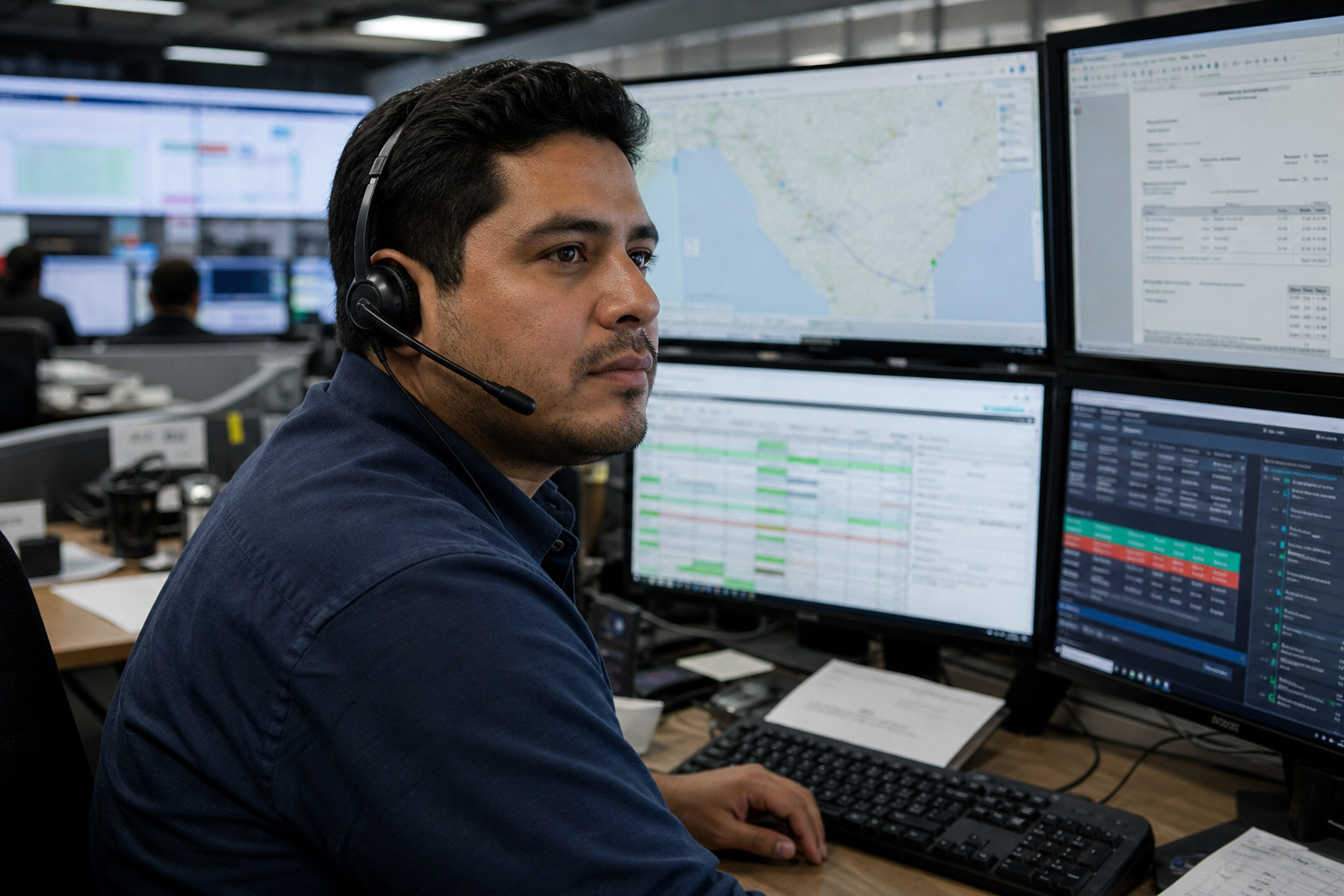
Dashboards, TMS, carrier portal, GPS, email, and a WhatsApp group per customer. From the committee it looks like industry 4.0. On the dock, the shipment is still person + loose systems + PDF.
The system looks full because someone filled it. If that person is out sick or leaves, the “digital” stops: Laredo appointments, POD in chat, and AP without a file the same day.
Past ~300+ shipments/month (the threshold in the 6-8 week playbook), hiring more tower feels inevitable.
Market guides we already publish cite cuts on the order of 60-70% of administrative time when you stop living in repetitive capture. While the bridge is human, that ceiling does not move.
That is not transformation. It is capture behind an expensive interface. The real cost is not only payroll:
- paying blind,
- losing OTIF to an alert nobody saw,
- scaling headcount every time Mexico–US volume rises.
Five fronts: where the money goes
Open the tabs in an average tower. None of the systems is dumb alone: the cost is who copies, pastes, chases, and forwards between them.
Every hop between fronts burns minutes and opens gaps where rate, GPS, or POD disappear.
ops.tower.local / shipment-4821
Five operating fronts
Five fronts. One human bridge
Each tab is a system. The cost is whoever stitches them.
Quote and assign
Rate card + carrier portal before assignment.
Trip record
TMS or Excel: stores capture; does not bridge fronts.
GPS tracking
Mirror account, map, and calls when it fails.
Evidence and invoice
POD + CFDI on the ID or AP pays blind.
Customer service and AP
Serve the customer and release pay from the same chaos.
While a human bridges every front, cost shows up in tower hours and freight without a file.
In dollars, the damage shows up in two places at once:
- Tower and AP hours that do not scale with volume without more people.
- Freight leakage: with typical sampling (~1 in 10 invoices) the rest of the flow pays without matching rate + CFDI + Carta Porte + GPS + POD.
That is why the OCL pattern when leaving sampling recovers 5-7% of spend in the audited universe: not magic, but a file that no longer lives in chat.
Go deeper in GPS mirror accounts and CFDI + Carta Porte + GPS + POD audit.
You buy licenses. You need finished work
In many ops, tower, traffic, and AP headcount already dwarfs licenses. Yet the purchase still fights over more screens.
The useful question is different: are you buying screens so your people keep running the work, or finished work that closes the shipment?
Licenses vs finished work
Today you buy screens and your people still run the work. What you need: AI agents that close the shipment; your team only sees exceptions.
Who does the day-to-day work?
You buy licenses / screens
Your people. Still grows with volume.
You buy finished work
Agents that operate your screens. Your team only sees exceptions.
What does success look like?
You buy licenses / screens
More users inside the TMS
You buy finished work
Closed shipment: assigned, tracked, POD, invoice ready
Can you verify it in dollars?
You buy licenses / screens
Hard: full dashboards, truth in WhatsApp
You buy finished work
Yes: balances, hold, or dispute with a file
Where does budget hit?
You buy licenses / screens
Capture payroll + AP sampling
You buy finished work
Cost per executed shipment + 5-7% recovery
| Question | You buy licenses / screens | You buy finished work |
|---|---|---|
| Who does the day-to-day work? | Your people. Still grows with volume. | Agents that operate your screens. Your team only sees exceptions. |
| What does success look like? | More users inside the TMS | Closed shipment: assigned, tracked, POD, invoice ready |
| Can you verify it in dollars? | Hard: full dashboards, truth in WhatsApp | Yes: balances, hold, or dispute with a file |
| Where does budget hit? | Capture payroll + AP sampling | Cost per executed shipment + 5-7% recovery |
Measure closed shipments, not users in the TMS.
CargoWise, Magaya, SAP, Oracle, GM Transport, or Excel can be good records. Executing the trip is a different product:
- assign,
- track,
- gather POD,
- leave the invoice ready.
If tendering lives in WhatsApp and the TMS only stores the summary, you do not have an execution system: you have an expensive archive.
Compare record vs execution in traditional TMS vs OCL and use the checklist to choose a TMS in Mexico before adding another license.
AI that helps vs AI that closes the work
“Does it have AI?” no longer helps. The CEO question is: who closes the operating work when volume rises?
An email summary does not free capacity on Bajío–Laredo. A closed workflow does:
- assigned,
- live GPS,
- POD bound,
- invoice ready or held.
The difference is not chat branding: it is whether the deliverable is an on-screen shortcut or a shipment AP can pay or dispute.
Operating capacity
The work someone still has to close when volume rises.
Automates tasks
- Summarize, suggest, extract a field
- Almost no tower capacity freed
- Still your team + tabs
Closes whole roles
- Closes the flow end to end
- Deliverable: finished work
- Frees capacity, does not only assist
Verifiable result
- Invoice balances a pay or dispute
- Hold or release with a cause
- POD bound to the trip ID
We do not sell another license.
We sell finished work.
For the technical detail of how an agent operates portals without a perfect API, read the computer use in logistics pillar.
The buying point is simple: point assistance does not lower the headcount ceiling; finished work does.
Record, trust, and work: in that order
There is a temptation to put AI on top of mess. It does not work: automating chaotic WhatsApp only accelerates the error.
The right order is:
- First: shipment data captured cleanly (ID, rate, carrier, milestones).
- Then: evidence that can actually pay (POD, GPS, invoice and docs bound to the trip).
- After that: automate.
Anyone can buy the AI model; the edge is your Mexico–US ops context (Laredo, appointments, Carta Porte, geofence, usable POD).
Three pieces. The edge is not the model.
AI model
Useful. Anyone can buy it.
System connections
Portals, APIs, trip rules.
Your operation
Mexico–US corridor, Carta Porte, POD.
Record, trust y work
- 1
Clean data
ID, rate, carrier, milestones up to date.
- 2
Evidence that can pay
POD, GPS, docs bound to the ID.
- 3
Finished work
Agents that actually close the trip.
Without record and evidence underneath, there is no finished work.
At the border, “almost digital” is not enough: a POD that will not open from the trip ID or a GPS nobody mirrors is detention risk, dispute risk, and blind payment.
The right order is what makes the pilot defendable to the CFO.
What OCL executes (without replacing your TMS at the outset)
With record and evidence in place, OCL Cargo (an autonomous TMS with computer use) operates screens and portals to close the flow on top of or beside your TMS.
Your team step in only when something does not close on its own. You do not need a multi-year replacement program: the healthy pattern is one measured lane.
Exceptions
The agent closes; you only see what escalates
Elige un paso para ver el detalle
Detalle del paso · 01
Assignment
That playbook already runs in live ops: on the OCL site we present live operations with Promologistics (partnership and implementation; no invented confidential client KPIs).
The public measurement bar stays the same: hours freed, 100% coverage of the pilot flow, and typical 5-7% recovery, not “looks smart” slides.
Proof in dollars, not demos
If you cannot say "the invoice balances or it does not," you do not have ROI: you have a story.
In measured pilots, moving from sampling to auditing 100% of the flow recovers on the order of 5-7% of freight spend in the audited universe.
Published reference (anonymous 3PL, not Promologistics): $3.6M MXN in unsupported charges in 6 weeks (5.7% of audited spend), with a conservative projection on the order of ~$18M MXN/year.
| Output the CFO cares about | How you prove it | Decision |
|---|---|---|
| POD tied to ID | Evidence bound to the trip, not the chat | Close delivery or dispute with a file |
| AP reconciliation | Rate + CFDI + Carta Porte + GPS + POD | Pay, hold, or dispute |
| Payment hold | Incomplete file or mismatch | Dollars do not leave without proof |
| Detention with geofence | Entry/exit timestamps | Demurrage charge with a base |
| Tower hours | Baseline vs pilot on the same corridor | Measurable capacity freed |
Important: running agents has cost (compute + exception supervision). That is why the pilot demands a margin test:
- hours freed,
- 100% coverage,
- dollars recovered,
not just a pretty demo.
If volume rises and margin stays flat because your team behind the curtain still copy between systems, you do not have an autonomous TMS: you have a team acting as the bridge with a chat on top.
A 6-8 week pilot
You do not need to replace SAP or Oracle on day one.
- Pick a corridor (e.g. Bajío–Laredo) or a high-volume customer.
- Freeze the starting point (capture hours, % of invoices reviewed, dollars in dispute).
- Run the flow with agents.
- Decide with numbers, not the feeling that “the tower can breathe again.”
Elige un paso para ver el detalle
Detalle del paso · 01
Pick a corridor or customer
Step 1
Step-by-step guide: stop capturing shipments in 6-8 weeks. If you still live in a spreadsheet, also cross TMS vs Excel in logistics to mark when the sheet no longer cuts it.
Key takeaways5 points
- If your tower is the bridge between systems and a PDF, you are not digitized: you are still capturing by hand behind a nicer interface, and risk scales with every shipment.
- You buy licenses (seats); what you lack is finished work: someone (or an agent) who closes the shipment with a file.
- The buying question is not “does it have AI?”. It is “who closes the operating work when volume rises?”.
- Verifiable ROI: the invoice balances or is held. 5-7% pattern auditing 100% of the pilot (published case: $3.6M MXN / 5.7% in 6 weeks).
- No day-one TMS replacement: 6-8 week pilot on one corridor, with hours and dollars as the decision.
Is your digitization just a human bridge?
A one-pager for leadership
Two pages to forward to the CFO or VP of operations: the right order before agents, and the commercial offer (finished work, not loose licenses).
Use them to align the purchase in one meeting, not as pitch decoration.
 OCL Cargo
Autonomous TMS · Right order
Record, trust, and work: in that order
Anyone can buy the AI model. The edge is your ops context. At OCL, order matters before you put agents on top.
Three pieces. The edge is not the AI model.
Anyone can buy it
AI model
- Very useful, not exclusive
- Anyone can use it
- Not your edge
Bridge
System connections
- Portals and screens
- APIs when they exist
- Shipment rules and exceptions
The edge
Your operation
- Mexico–US corridor
- Carta Porte, geofence, POD
- Repeatable: not only in heads
That is why order matters
- 1
Shipment data captured cleanly
One source of truth: ID, rate, carrier, milestones.
- 2
Evidence that can pay
POD, GPS mirror, and invoice/docs bound to the ID.
- 3
Finished work
Agents that close the trip on that clean record.
- Assignment
- GPS mirror
- POD/Tower
- Pre-pay audit
Your operation is the edge.
An agent is only as good as the record underneath.
- Autonomous TMS
- Screen agents
- Finished work
- Pilot 6-8 weeks
OCL CargoCommercial · Capacity
We sell finished work
Generic AI automates tasks. Ops AI closes the work: from assistant to operator, with a dollar-verifiable result.
Generic AI
- Summarizes, suggests, extracts a field
- Flow stays human + bridge between systems
- Almost no tower capacity freed
Ops AI (OCL)
- Closes the flow end to end
- Deliverable = finished work
- Frees capacity: does not only assist
What you are really buying
Ceiling = payroll
Licenses (seats)
- More users on screen
- “Full” dashboard, truth in WhatsApp
- Tower stays the ceiling
Measurable capacity
Finished work
- Lower cost per shipment
- Balances / hold / POD ready
- Hours freed you can count
Verifiable result
Does the invoice balance?
Pay or dispute with a file
Is there evidence?
Hold payment or release AP
Not another TMS license.
We sell finished work: assignment, GPS mirror, POD/Tower, pre-pay audit.
- Typical recovery 5-7%
- Pilot 6-8 weeks
- Autonomous TMS
- Screen agents
Related reading
- Computer use in logistics
- Traditional TMS vs OCL
- 6-8 week guide
- CFDI + Carta Porte + GPS + POD audit
- GPS mirror accounts
- 3PL case: $3.6M MXN in 6 weeks
- Checklist to choose a TMS in Mexico
- Promologistics and OCL Cargo (in live operations)
- Freight customer service: more volume
- Control tower: tracking and volume
- Freight AP and pre-pay audit
- 8 business processes with AI agents in freight
Frequently asked questions
Because that TMS (CargoWise, Magaya, SAP, Oracle, GM Transport, or Excel) records what someone types in. The real trip still lives in carrier portals, WhatsApp, and PDFs. OCL does not ask you to abandon the record: it executes the work on top of or beside it. See traditional TMS vs OCL.
Not at the outset. It is an autonomous TMS with computer use: it operates screens and closes the flow. The healthy pattern is a 6-8 week pilot on one corridor (e.g. Bajío–Laredo). Guide: stop capturing.
Verifiable finished work: carrier assignment, GPS mirror, POD bound to the tower, and pre-pay audit (rate + CFDI + Carta Porte + GPS + POD). Not another login.
Moving from sampling to auditing 100% of the pilot flow typically recovers 5-7% of freight spend in the audited universe. You also measure tower hours freed and payments held with a file. Published reference: 3PL case study ($3.6M MXN / 5.7% in 6 weeks).
Shippers and 3PLs on Mexico–US with ~300+ shipments/month, multi-carrier networks, and AP that still pays on sampling or parallel Excel.